When a commercial roof leaks, do three things in order. Protect people and contents inside the building. Document the damage. Then bring in a qualified roofing contractor to find the source and make a lasting repair. Anything you do on the roof yourself is temporary at best, and it can make the leak harder to trace. This guide covers each step, how repairs differ by roof type, what drives the cost, and how insurance usually treats a leak.
TL;DR
- Act in the first hour: move stock and equipment, contain the water, shut off power near wet areas and photograph everything.
- Stay off a damaged or wet roof. Leak location inside the building rarely matches the entry point on the roof, so a trained inspector should trace it.
- Repair method depends on the roof system: membrane patches, flashing work, sealants, coatings or spray foam each fit different failures.
- Insurance generally pays for sudden, covered events, not gradual wear. Check your policy and report quickly.
- We install and service spray foam roofing across the Bay Area. Contact us for an assessment of your roof.
Table of Contents
- What to do in the first hour
- How to find where a commercial roof is leaking
- Temporary protection versus a permanent repair
- Common repair methods by roof type
- What affects the cost of a commercial roof leak repair
- Does commercial insurance cover a roof leak?
- Our perspective on commercial roof leaks
- Choosing a contractor for a leaking commercial roof
- Get your roof assessed by our Bay Area crews
- FAQ
- Sources
What to do in the first hour
Speed matters. Risk engineers at AIG say immediate action is vital after water intrusion and that the first hour can make a big difference to the total loss. They also recommend that facilities have a water-damage plan and know their mitigation and remediation resources before they need them.
A practical sequence for a property manager:
- Protect people first. Cordon off wet floors. Keep occupants away from ceilings that sag or bulge, because trapped water can release suddenly.
- Deal with electrical risk. Water near lighting, panels or rooftop equipment is a shock hazard. OSHA’s electrical safety guidance includes deenergizing equipment before inspection or repair. If water is near live circuits, have a licensed electrician make the area safe.
- Contain the water. The SPRI/NRCA emergency-repair manual suggests protecting the interior with containers or plastic sheeting. Cover inventory, move records and equipment, and place buckets under drips.
- Document everything. Take dated photos and video of the ceiling, walls, floors and any damaged contents. Note when the leak started and the weather at the time. You will need this for your insurer and your contractor.
- Call a roofing contractor. NRCA advises owners to use professional roofing contractors for emergency repairs where possible.
Why not just climb up and patch it?
It is tempting, but it is rarely wise. NRCA guidance says a damaged or visibly unsafe roof deck should not be walked until its safety has been established. A wet membrane is slippery, and a deck weakened by long-term moisture may not carry weight. Fall protection and electrical hazards are also recurring problems on commercial roofs: in one case, OSHA found a roofing contractor had exposed workers to fall hazards without protection and to electrical hazards by not deenergizing circuits.
There is a practical reason too. Smearing roof cement over the wrong spot hides the real entry point and makes the permanent repair harder.
How to find where a commercial roof is leaking
Water travels. It enters at a seam or flashing, runs along the deck or through insulation, and drips from a light fixture thirty feet away. So the stain on the ceiling is where to start looking, not where to repair.
A systematic inspection usually covers:
- Interior leak locations, mapped against the roof plan.
- Flashings at walls, curbs, parapets and edges.
- Penetrations such as vents, pipes, conduits and skylights.
- Rooftop equipment, including HVAC units, condensate lines and their supports.
- Drains, scuppers and gutters, checked for debris and standing water.
- Seams and field of the roof, looking for punctures, blisters, splits and open laps.
NRCA’s inspection guidance lists these same areas: interior leak locations, flashings, penetrations, rooftop equipment and drains. Roofing Canada’s reference manual adds that finding a leak starts with reviewing the problem and then systematically inspecting the roof and adjacent walls and equipment, with trained personnel sometimes using thermographic inspection or electronic leak detection.
Leak detection has limits
No single test finds every leak. IIBEC notes that leak-detection methods each have limitations and that their effectiveness depends on conditions such as the conductivity of the substrate, the presence of water and the weather. A good contractor often combines a visual survey, moisture mapping and a targeted test rather than relying on one method.
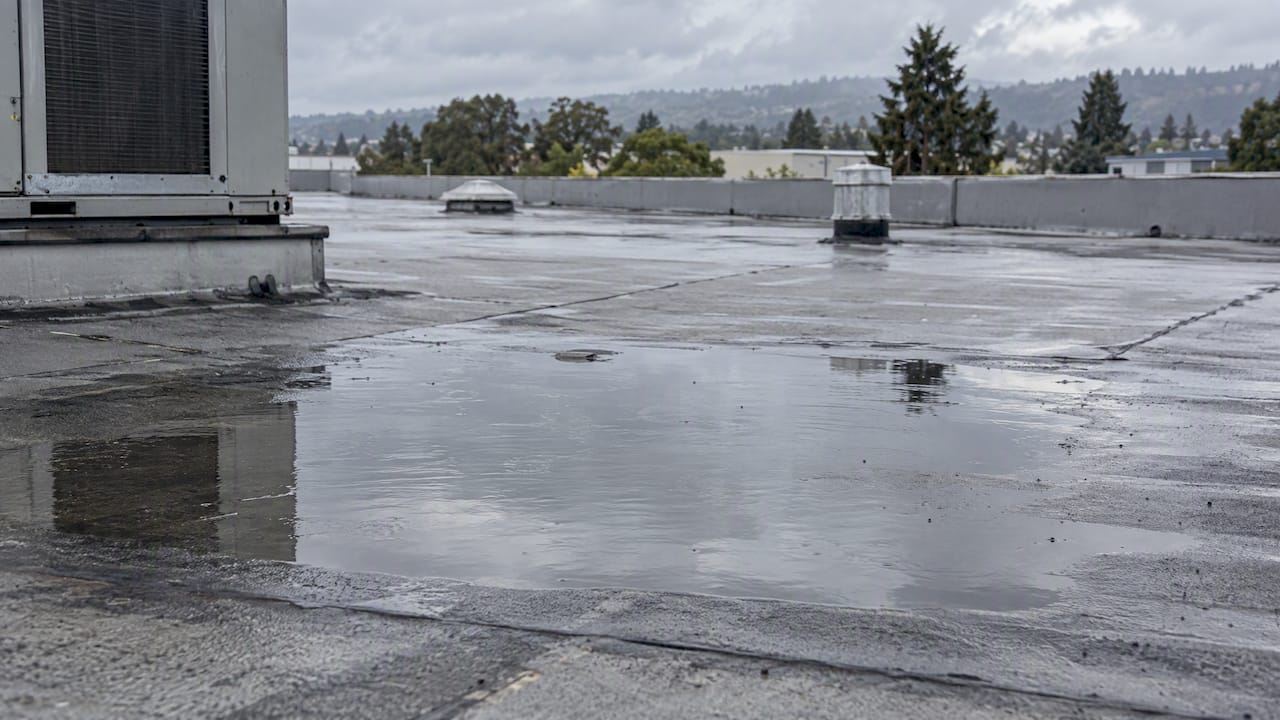
Check for ponding water
Standing water is both a symptom and a cause. NRCA explains that ponding water lasting more than 48 hours can be detrimental to a roof assembly. If you see puddles two days after rain, mention it to your contractor. Slope, blocked drains or deck deflection may be involved, and patching a seam will not cure those.
Temporary protection versus a permanent repair
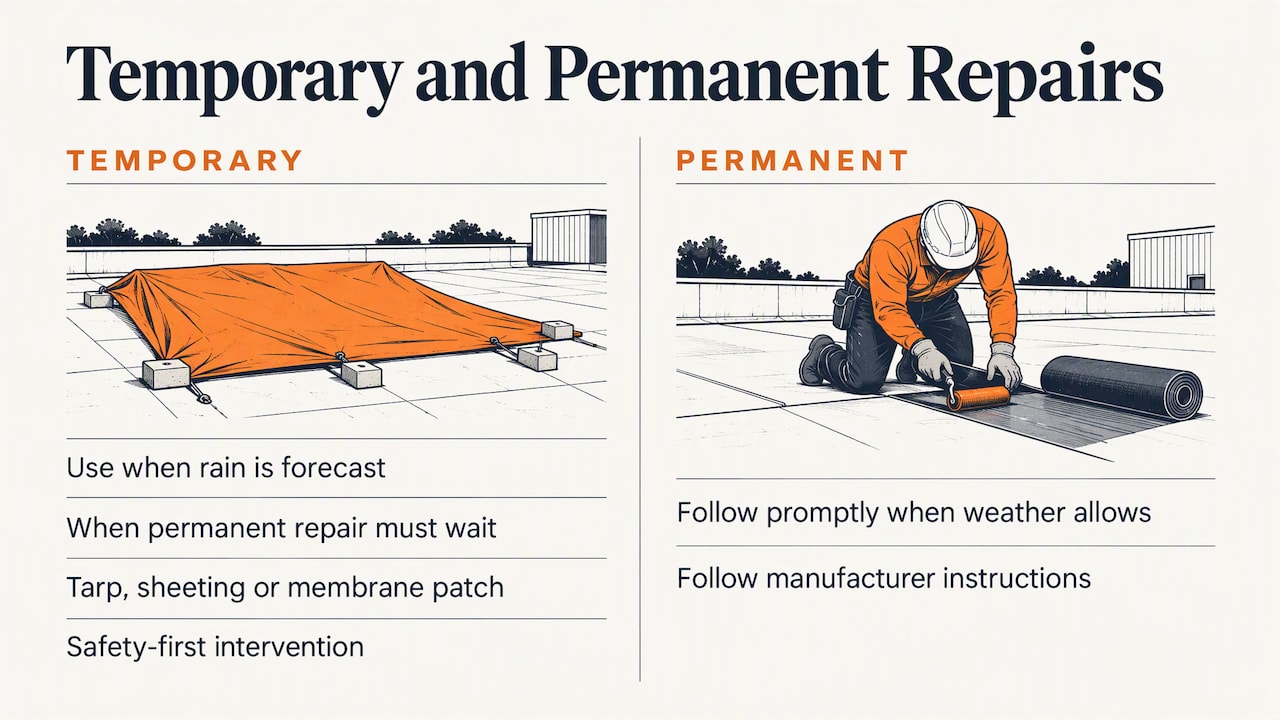
A temporary cover, such as a tarp, sheeting or a temporary membrane patch, makes sense when rain is forecast and a permanent repair cannot happen yet. SPRI and NRCA frame emergency work as a safety-first, temporary intervention. Permanent work should follow promptly when weather allows, and manufacturer instructions should guide repairs specific to your system.
Two habits help here. Control rooftop access, and keep a log of who goes up there, as NRCA recommends. Tradespeople servicing HVAC units are a common source of punctures and disturbed flashings, and a log shows who was on the roof before a leak appeared.
Common repair methods by roof type
There is no universal fix. The right repair depends on what the roof is made of, how old it is and why it failed.
| Roof system | Typical failure | Common repair approach |
|---|---|---|
| Single-ply (TPO, PVC, EPDM) | Open seams, punctures, shrunken flashing | Clean and patch with compatible membrane, re-weld or re-adhere seams, replace flashing |
| Built-up or modified bitumen | Blisters, cracked flashing, ridging | Cut out and replace affected plies, re-flash edges, apply a compatible coating |
| Metal | Loose fasteners, failed seam sealant, rust at laps | Replace fasteners, re-seal seams and laps, coat or treat corrosion |
| Spray polyurethane foam (SPF) | Mechanical damage, coating wear | Cut out damaged foam, re-spray, restore the protective coating |
| Any system, widespread aging | Many small leaks | Restoration with a coating or a full recover |
The categories below describe what each repair involves.
Patching
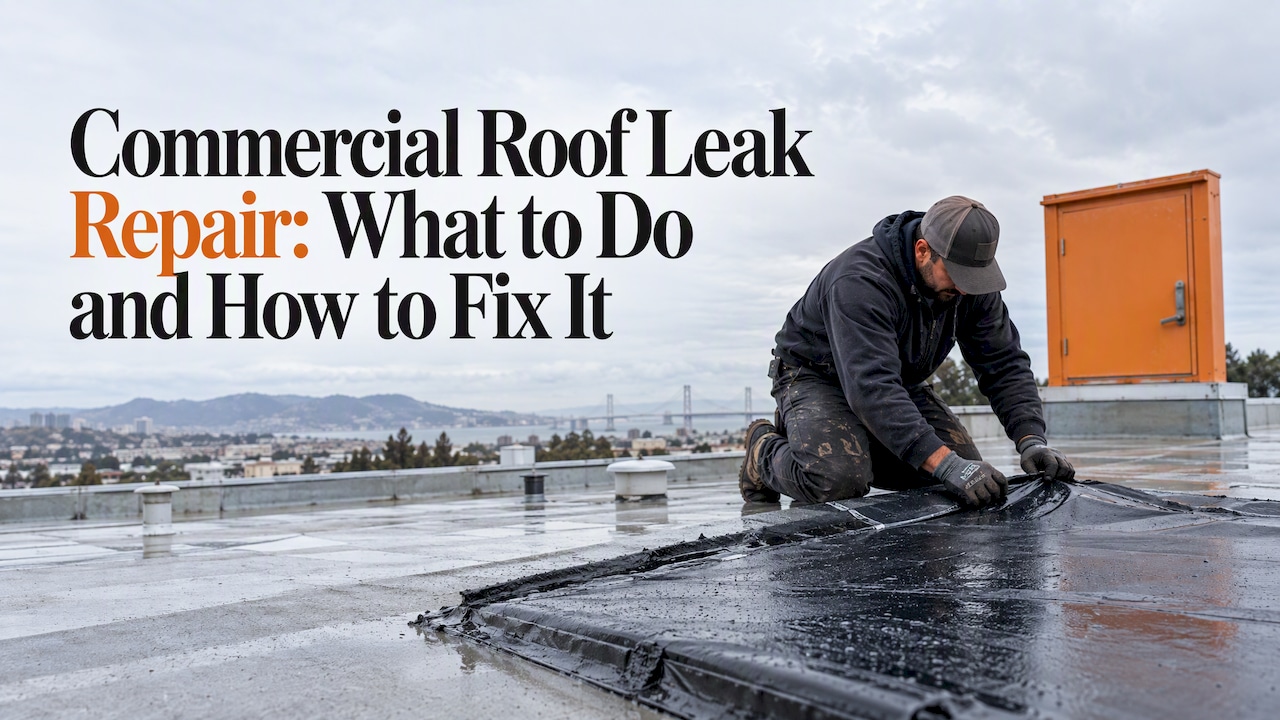
Patches suit isolated punctures, tears and small open seams. The patch has to be compatible with the existing material, and the area must be clean and dry. A patch over wet insulation traps moisture, so a moisture survey before patching saves repeat calls.
Flashing replacement
Most commercial leaks start at transitions, not in the open field: wall edges, curbs, pipe penetrations and parapets. When flashing has cracked, pulled away or shrunk, replacing it is the lasting answer, not adding more sealant.
Sealants
Sealant works for small gaps, fastener heads and minor movement joints. It is a maintenance product, and it should be inspected on a schedule because it can weather and open again.
Coatings
A coating can seal and protect a roof that is structurally sound but worn on the surface. It is a restoration step, not a cure for wet insulation or a damaged deck. Roofs in California may also have energy-code obligations when a large share of the roof is redone. A summary of Title 24 explains that cool-roof rules apply to re-roof or recover projects covering more than 50% of the existing roof. Ask your contractor how the current code applies to your scope, and check with your local building department.
Spray foam roofing
Spray polyurethane foam is applied as a continuous, seamless layer and then protected with a coating. Because there are no laps to open, it removes one of the most common leak paths on flat and low-slope roofs. It also adds insulation value to the roof. We cover it on our spray foam roofing page, and our spray foam roofing articles go deeper on how it behaves on different substrates.
What affects the cost of a commercial roof leak repair
Commercial roof repairs are priced by scope, not by a standard rate. A single accessible patch costs far less than repairing seams across a section with wet insulation beneath. The main drivers:
- Size and number of repair areas. One puncture or a dozen.
- Roof system and materials. Each membrane needs compatible patch materials and methods.
- Hidden moisture. Wet insulation or deck must be removed and replaced, which adds labor and materials.
- Access. Height, rooftop obstacles, occupied space below and after-hours work.
- Drainage and slope problems. If water ponds, the repair may include drain work or tapered insulation.
- Roof age. On an aging roof, a repair can be a bridge to restoration or replacement. A fair contractor tells you when repairs stop making sense.
We do not publish a fixed price for roofing work, because the scope has to be seen. What we can tell you is that our estimates are transparent and we recommend a less expensive option when it will do the job. If you want a number, we assess the roof first, explain what we found and quote only for what is needed.
Does commercial insurance cover a roof leak?
It depends on the cause. Commercial property policies usually respond to sudden events named in the policy. A law firm that handles roof claims explains that water damage from a leak is generally covered only when a covered event caused it, such as hail damaging the roof, and that gradual wear and tear or poor maintenance often leads to denial.
What that means in practice:
- Report quickly. Policies often require prompt notice and reasonable steps to prevent further damage. Temporary protection and mitigation are usually expected.
- Keep records. Photos, maintenance logs, inspection reports and invoices support your claim.
- Ask your contractor for a written cause-of-loss description if you plan to file.
- Read the policy or call your broker. Exclusions, deductibles and limits vary by policy, and only your insurer or broker can tell you how yours applies.
Regular maintenance helps on both fronts. It reduces leaks, and it shows you have kept the roof in a condition insurers expect.
Our perspective on commercial roof leaks
Most leak calls we hear about start the same way. A patch went on, the next storm came, and the leak returned a few feet away. The cause is usually that the repair addressed where water showed up, not where it got in, or that the roof system itself has too many seams and transitions to stay tight.
That is why we pay attention to the whole building envelope. Our in-house crews handle roofing, insulation and coatings, so we look at how the roof, the insulation beneath it and the walls work together. Where a simple repair will do, we say so. We would rather give you a smaller, honest scope than sell work you do not need.
Where a flat or low-slope roof keeps leaking at seams, spray foam roofing is the system we recommend you consider. It goes on as one continuous layer, adds thermal resistance and can be maintained with targeted recoating. Our crews are certified and licensed in California, we build to California energy and building code standards, and our work carries a workmanship warranty.
the author
Choosing a contractor for a leaking commercial roof
Before you sign anything, ask:
- Will you find the source before quoting? A quote given over the phone for a leak you have not inspected is a guess.
- Is the contractor licensed in California, and are the crews trained on your roof system? Request proof.
- Do they follow the manufacturer’s repair instructions? This protects any existing roof warranty.
- Will the repair be documented? Photos before, during and after help with insurance and future maintenance.
- Is there a workmanship warranty, and what does it cover? Get it in writing.
- Do they tell you when repair is not enough? A contractor who only ever sells replacement, or only ever sells patches, is not assessing your roof.
If your building also has comfort or energy problems, such as hot upper floors or condensation, ask whether the roof and insulation can be addressed together. Our commercial insulation team works on the same envelope, and our commercial insulation articles explain the options.
Get your roof assessed by our Bay Area crews
If you manage or own a commercial building in the San Francisco Bay Area and a roof is leaking, we can inspect it, explain the cause in plain language and recommend the most economical repair that will last. For flat or low-slope roofs with recurring seam leaks, we will also walk you through spray foam roofing as a lasting option.

See everything we do on our services page, or contact us through our website to schedule an assessment.
FAQ
How long can a commercial roof leak go before it causes serious damage?
There is no safe interval. Water soaks insulation, corrodes fasteners and can weaken the deck, and AIG’s risk engineers stress that the first hour can change the total loss. Contain the water at once and arrange an inspection as soon as it is safe.
Can I repair a commercial roof leak myself?
For safety, we advise against going on the roof. Damaged decks, wet surfaces and electrical equipment are real hazards, and NRCA says a visibly unsafe deck should not be walked until its safety is established. Interior containment is something your staff can do. The roof work itself belongs to a contractor.
Does commercial insurance cover roof leaks?
Sometimes. Coverage generally depends on whether a covered event, such as hail, caused the damage, and wear and tear is usually excluded. Report the leak promptly and confirm the details with your insurer or broker.
Why does my roof keep leaking after repairs?
Usually the repair was not at the true entry point, or the cause is bigger than a patch: wet insulation, failed flashing, ponding water or an aging membrane. A proper inspection traces the source and checks for those conditions. Ponding that lasts more than 48 hours is worth raising with your contractor.
When should I replace or restore the roof instead of repairing it?
When leaks are frequent, insulation is widely wet or the membrane is near the end of its life, repeated repairs cost more over time than a restoration or recover. A contractor should show you moisture findings and compare options. We will tell you when a simple repair is enough.
Sources
- AIG Property Risk Engineering Insight: Water Intrusion
- OSHA electrical safety work practices
- SPRI/NRCA Manual of Roof Inspection, Maintenance and Emergency Repair, Single-Ply
- NRCA guidance on emergency repairs and roof access
- NRCA guidance on roof inspection and unsafe decks
- OSHA news release on roofing contractor hazards, June 2023
- Canadian Roofing Reference Manual: Locate the Problem Area
- IIBEC: The Leak Stops Here
- NRCA on roof slope, drainage and ponding water
- Title 24 cool roof requirements summary
- Claiming roof damage for your commercial property
Recommended
- Spray Foam Roofing Articles
- Spray Foam Roofing (SPF) San Francisco & Bay Area
- Insulation, Roofing & Coating Services
- Polyurea Coating San Francisco & Bay Area
Made with BabyLoveGrowth to build contextual backlinks
Get an Instant Quote From a Licensed California Insulation Contractor
USA Spray Me (CSLB Lic# 1058008) installs spray foam, blow-in, fiberglass and soundproofing insulation, foam roofing and protective coatings throughout the San Francisco Bay Area and within 100 miles of the city. Call (855) 566-5340 or request a free inspection below — save $250 on orders over $2,500.