- Spray foam (open- and closed-cell) seals air completely, higher R per inch, controls moisture; suits coastal/fog-prone areas
- Fiberglass costs less upfront but seals air poorly, lower thermal resistance, shorter life
- 2025 code updates demand tighter air leakage; spray foam meets it more easily, fiberglass needs extra materials
- Spray foam cuts heating/cooling costs 25-40% vs 5-15% for fiberglass
- Fiberglass acceptable for interior walls, garages, budget builds
- What Changed in 2025 – And Why This Comparison Matters
- Open-Cell & Closed-Cell Spray Foam – Properties & Best Uses
- Fiberglass Batts – Properties & Best Uses
- Spray Foam vs Fiberglass – R-Values & Thickness
- When to Use Spray Foam vs Fiberglass
- San Francisco Specific Climate Recommendations
- 2025 Building Codes & Sustainability Trends
What Changed in 2025 – And Why This Comparison Matters
The 2024 IECC update and the 2025 California Title 24 revision raise R-value and air-leakage requirements.
1. Title 24 (2025 Revision)
Spray foam helps meet the new rules; fiberglass requires air barriers, tapes or rigid foam to pass inspection. New requirements: higher wall and roof R-values, much stricter air-leakage limits, lower moisture permeability in exterior assemblies, mandatory energy modeling for many projects.
- Higher wall and roof R-values
- Much stricter air-leakage limits
- Lower moisture permeability in exterior assemblies
- Mandatory energy modeling for many projects
2. Climate Shifts in California
Northern California faces fog and humidity (San Francisco, Pacifica, Half Moon Bay), salt air, quick temperature changes and wind-driven air infiltration. Fiberglass cannot stop air movement; spray foam addresses the problem at its source.
3. Environmental Regulations
As high-GWP HFCs are phased out, closed-cell foam now uses HFO blowing agents that cut greenhouse gas emissions by up to 99%. Fiberglass makers have increased recycled glass content.
Open-Cell & Closed-Cell Spray Foam – Properties & Best Uses
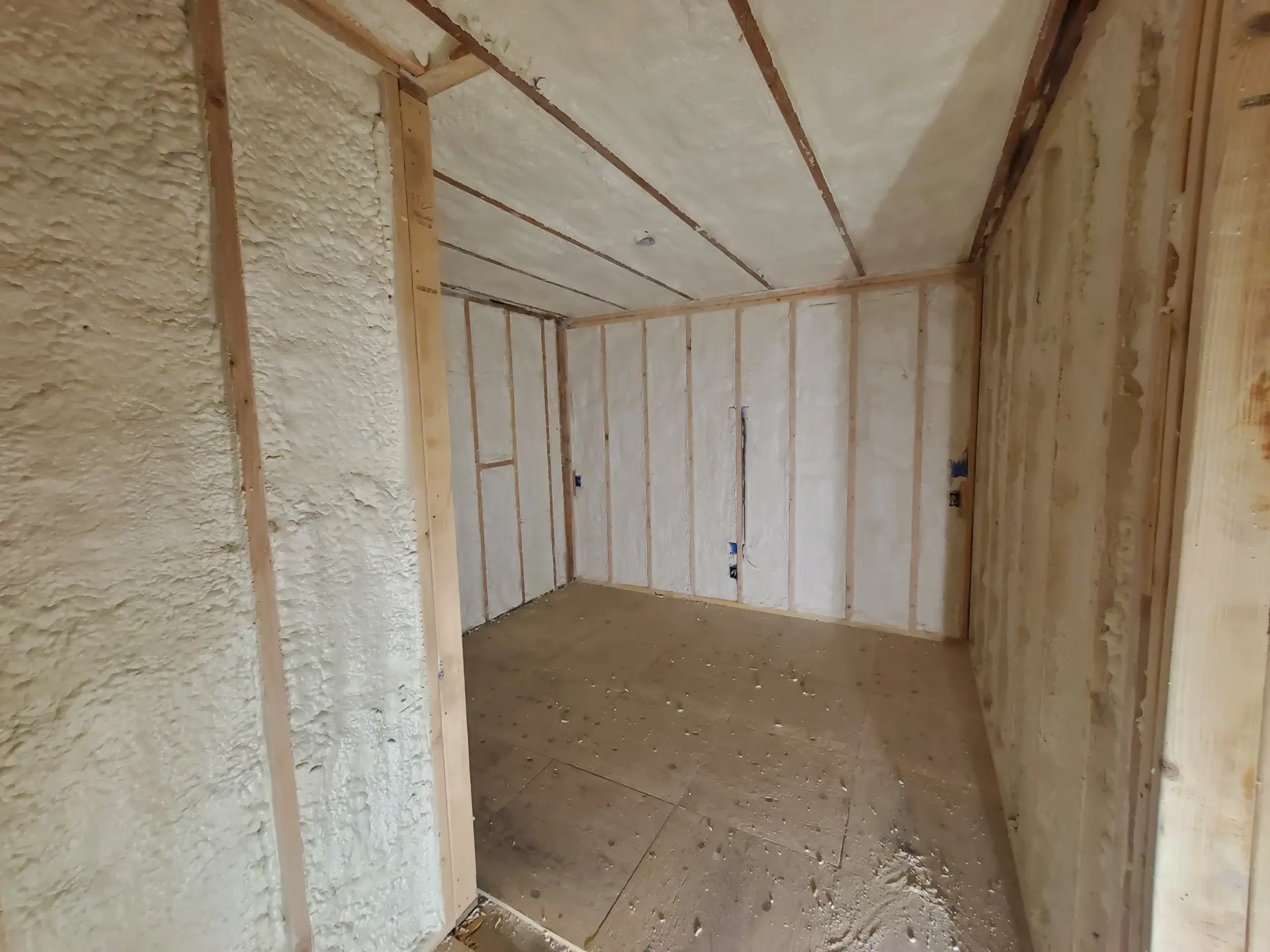
SPF is sprayed as a liquid that expands to fill a cavity, providing insulation and air sealing in one step.
Technical Specifications (Spray Foam)
Open-cell: R-3.5 to R-3.8 per inch, expands to fill irregular spaces, absorbs sound. Closed-cell: R-6 to R-7 per inch, rigid moisture barrier, adds structural strength. Both outperform fiberglass in air sealing, durability and long-term efficiency.
- Open-cell R-3.5–R-3.8/in
- Closed-cell R-6–R-7/in
Where Spray Foam Excels
Recommended for attics, roofs, rim joists, crawl spaces and exterior walls. In San Francisco's fog belt (Sunset, Richmond, Daly City, Pacifica), closed-cell prevents condensation, mold and thermal bridging. Retrofits benefit because high R-values fit limited space and foam compensates for irregular older framing.
Important Limitations (Spray Foam)
Costs more upfront and requires certified installers. Closed-cell usually needs an ignition barrier and careful ventilation planning.
Fiberglass Batts – Properties & Best Uses
Pre-cut panels made from spun recycled glass fibers; the most widely used and budget-friendly insulation in the U.S.
Technical Specifications (Fiberglass)
R-2.9 to R-3.8 per inch depending on density and thickness. Real-world performance varies because fiberglass does not stop air movement; gaps, compression and moisture reduce effective R-value.
- R-2.9–R-3.8/in
Licensed, bonded & insured — free on-site inspections within 100 miles of San Francisco. Save $250 on orders over $2,500.
Where Fiberglass Excels
Interior partition walls, garages, unfinished basements, places where air sealing matters less. Cost-effective for large new-construction projects.
Important Limitations (Fiberglass)
Performs poorly in humid or windy conditions, settles over time, absorbs moisture. Coastal California homes often see faster fiberglass degradation from fog and wind pressure.
Spray Foam vs Fiberglass – R-Values & Thickness
Side-by-side comparison table.
| Property | Spray Foam | Fiberglass Batts |
|---|---|---|
| R-Value per inch | R-3.5–R-7 | R-2.9–R-3.8 |
| Air Sealing | Excellent | Poor |
| Moisture Control | Excellent (closed-cell) | Very limited |
| Sound Control | Superior (open-cell) | Moderate |
| Structural Strength | Strong (closed-cell) | None |
| Lifespan | 50–80+ years | 10–25 years |
| Typical Uses | Exterior envelope | Interior walls, budget installs |
Real-World Example
To reach R-38 in a San Francisco attic: open-cell 10-11 inches, closed-cell 5.5-6.5 inches, fiberglass 12-14 inches plus an air barrier to meet 2025 code.
- Open-cell 10–11 in
- Closed-cell 5.5–6.5 in
- Fiberglass 12–14 in + air barrier
When to Use Spray Foam vs Fiberglass
Decision guidance.
Choose Spray Foam If:
Maximum efficiency, moisture protection, high R-value in limited space, long-term durability. Specifically recommended for foggy coastal areas such as San Francisco, Half Moon Bay and Pacifica.
Choose Fiberglass If:
Interior walls, tight budgets, or mild inland climates where moisture and air leakage are minor concerns.
San Francisco Specific Climate Recommendations
Climate-region table.
| Region | Climate Challenge | Recommended Insulation |
|---|---|---|
| Coastal (San Francisco, Daly City, Pacifica) | Fog, humidity, and wind | Spray foam performs best |
| Central Valley (Sacramento, Fresno) | Extreme heat | Closed-cell foam for roofs/walls |
| Mountain & High Desert | Cold winters and limited wall depth | Closed-cell foam for max R-value |
| Inland Mild Zones | Moderate conditions | Hybrid: closed-cell outside, fiberglass inside |
2025 Building Codes & Sustainability Trends
Title 24 emphasizes airtightness and moisture management. Spray foam serves as insulation, air barrier and moisture control in one layer; fiberglass needs extra steps for energy modeling and blower-door testing. Foam's shift to low-GWP materials plus reduced HVAC use and better thermal stability lowers lifetime carbon impact. Introduces USA Spray Me (San Francisco) as a Title-24-compliant spray foam provider.
Get an Instant Quote From a Licensed California Insulation Contractor
USA Spray Me (CSLB Lic# 1058008) installs spray foam, blow-in, fiberglass and soundproofing insulation, foam roofing and protective coatings throughout the San Francisco Bay Area and within 100 miles of the city, including Daly City, Pacifica, Half Moon Bay, Sacramento. Call (855) 566-5340 or request a free inspection below — save $250 on orders over $2,500.