
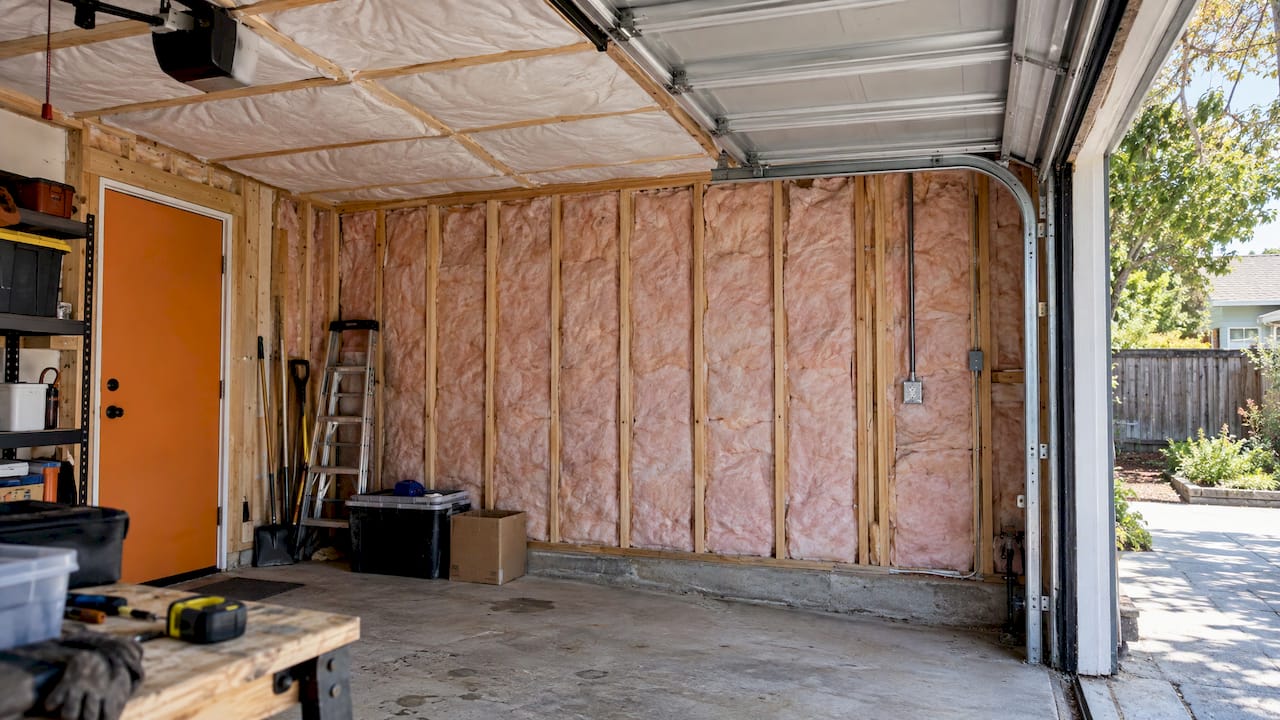
A detached garage has no heated house next to it, so insulation works differently there. In an unheated garage it slows temperature swings and keeps out drafts. In a garage you heat, cool or work in, it has to hold a real thermal boundary. The right plan depends on that choice. Start with the ceiling and air sealing, then the door, then the walls. If you want it done once and to code, our crews at USA Spray Me insulate garages across the San Francisco Bay Area with spray foam, closed-cell foam, fiberglass and blown-in insulation.
TL;DR
- Without a heat source, insulation mostly slows temperature swings. With a heater, an air conditioner or a workshop, it does far more.
- Match the weakest link: ceiling first, then the door, then the walls. Air sealing comes before any of them.
- Foam on an interior face needs a 15-minute thermal barrier, usually 1/2-inch drywall, under the International Residential Code.
- A two-car garage typically runs from a few hundred dollars for batts to several thousand for foam, depending on the surfaces and the R-value.
- Moisture is the hidden risk: a wet car in a cold garage can move condensation to a new cold surface if air sealing and vapor control are skipped.
Table of Contents
- Should a detached garage be insulated at all?
- Why the weakest link sets the result
- Which insulation works in each part of the garage
- What a two-car garage costs to insulate
- Fire safety and code rules that apply
- Moisture: the part most plans skip
- How the job goes, step by step
- Perspective
- Getting it done
- FAQ
- Sources
Should a detached garage be insulated at all?
It depends on what the garage is for. An unheated detached garage is not legally required to be insulated, and a modest R-13 wall and R-19 ceiling already make the space noticeably more comfortable. Without a heat source, though, the interior still follows the outdoor temperature through a long cold or hot stretch. Insulation slows that swing rather than holding a set temperature.
Insulate seriously when any of these apply:
- You will run a heater or air conditioner, so you want to keep the conditioned air in.
- You use the garage as a workshop, home gym, studio or office.
- You store paint, tools, wood, instruments or other items that suffer from swings in temperature and humidity.
- There is a room above the garage.
- You want to cut noise from power tools or a band.
For a workshop or any space you condition, treat the garage like a small house. Insulate the whole shell: roof or ceiling, walls, door and air sealing. Leaving one big gap wastes the rest.
Why the weakest link sets the result
A common mistake is putting thick insulation in the walls of a garage that still has an uninsulated steel door and a bare slab. One cost analysis puts it bluntly: the space reaches ambient temperature within a couple of hours of a weather change when the door and slab are left untouched. Its advice is to match the weakest link, and prioritize the ceiling, then the door, then the walls.
A practical order for most detached garages:
- Air seal. Close gaps at the sill plate, around windows, the door perimeter and every penetration.
- Ceiling or roof. Heat and cold move through it fastest, and one guide notes that up to 30% of heat can escape through the roof.
- Garage door. An old steel door has an R-value of about zero, and insulated sectional doors range from R-8 to R-32.
- Walls. Decide after you have used the space for a season, if the garage stays unheated.
- Slab edge. Mainly for colder climates where the floor will be heated or finished.
Which insulation works in each part of the garage
Ceiling and roof
The ceiling target depends on what sits above. For a ceiling under living space, one guide suggests R-19 to R-30 between joists. For an open attic above, the same guide targets R-38 to R-49 in colder zones, with air sealing first and baffles kept at the eaves. The 2021 energy code tables list ceiling values of R-30, R-38 and R-49 by climate zone, and the 2024 edition keeps ceiling minimums in that range. Those numbers apply to the conditioned thermal envelope. For an unconditioned detached garage they are a useful benchmark, not a requirement.
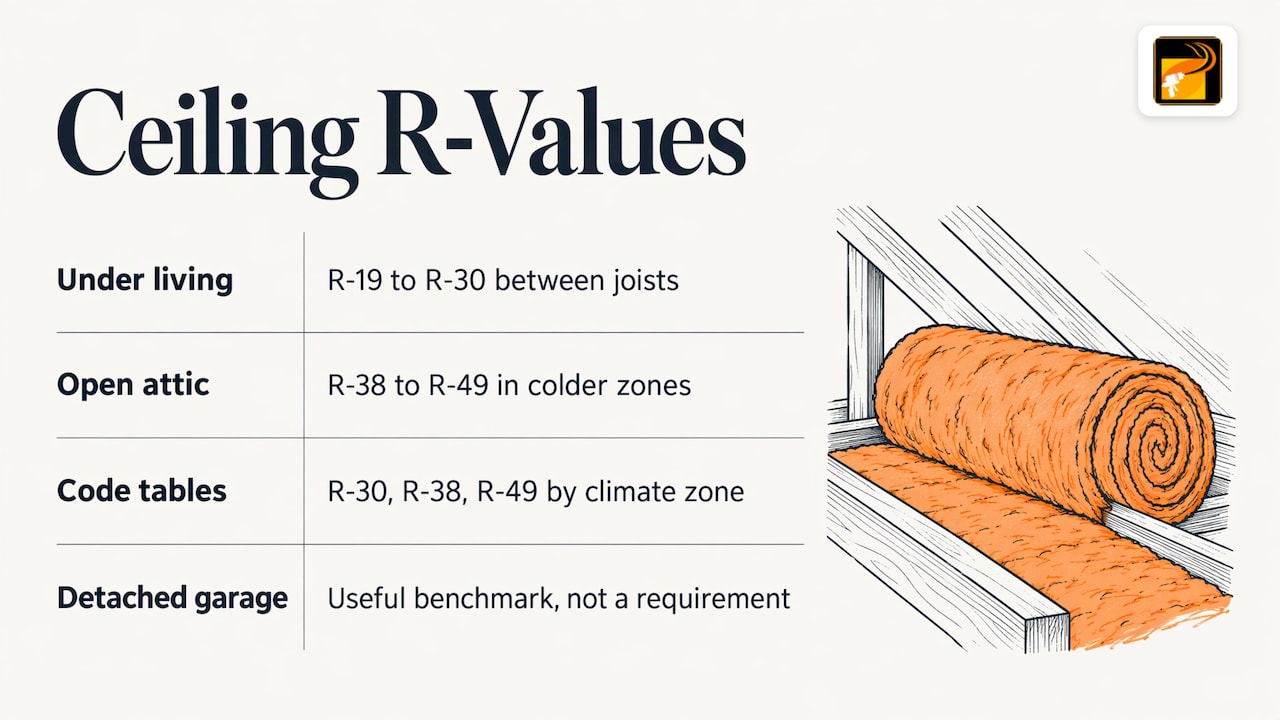
Blown-in insulation suits an open attic with a flat ceiling. Spray foam suits a roof deck, a vaulted ceiling or a garage with a room above, because it seals and insulates in one pass. Our spray foam vs. blown-in comparison lays out cost and R-values side by side.
Walls
For a 2x4 wall, the energy code tables use R-13 to R-15. For a 2x6 wall they use R-19 to R-21, with added continuous insulation in the coldest zones. Fiberglass batts are the economical choice. Closed-cell foam gives a higher R-value per inch in a thin cavity and seals air leaks at the same time. If you are weighing the two, see our spray foam vs. batts comparison.
Garage door
A standard uninsulated steel door is only about R-1 to R-2, and a retrofit kit lifts it to roughly R-8 to R-10. Replacing it with an insulated door is the bigger step. The door is also the largest single air leak in most garages, so a good bottom seal and perimeter weatherstripping matter as much as the R-value.
Slab
A concrete slab stays cold and pulls heat from the room. In zones 5 to 8, slab-edge foam of R-10 to R-15 is common practice. In milder climates, such as most of the Bay Area, the ceiling, door and walls give more benefit per dollar.
What a two-car garage costs to insulate
Prices vary widely with the material, the R-value, whether drywall is already up and the access. Published figures for a typical two-car garage give a sense of the range:
| Surface (two-car garage) | Fiberglass batts | Closed-cell foam |
|---|---|---|
| Walls (about 400 sq ft) | $200–$900 | $600–$3,000 |
| Ceiling | $400–$1,150 | $1,500–$3,000 |
Those installed ranges come from a 2026 garage insulation cost table. The same source lists a door retrofit kit at $90–$300 for DIY plus $150–$300 for a professional, and an insulated double door replacement at $1,100–$4,200 installed. Another guide puts walls and ceiling of an unfinished two-car garage at $800–$5,100, and $1,600–$12,800 when finished drywall has to be removed and rehung.
Our own published ranges for the Bay Area, as listed on our service pages:
- Spray foam insulation: $1.00–$2.50 per board foot (one square foot, one inch thick)
- Closed-cell insulation: $1.50–$2.50 per board foot
- Fiberglass insulation: $0.50–$2.50 per sq ft
- Blow-in insulation: $1.20–$3.50 per sq ft
- Insulation removal: $1–$2 per sq ft
A board foot is an inch of thickness over one square foot. A 400 sq ft wall with 2 inches of foam is 800 board feet, so multiply by the rate for your material to estimate. The final number depends on the thickness for your target R-value and on the condition of the structure.
Fire safety and code rules that apply
Two rules catch people out.
Foam needs a thermal barrier. Under section R316.4 of the International Residential Code, spray foam, polyiso, XPS and EPS exposed on the interior face of an occupied space, a garage included, must be covered by an approved 15-minute thermal barrier. The default is 1/2-inch gypsum wallboard. Tested intumescent coatings can substitute, and one source puts them at $1.00–$2.00 per sq ft. An uninsulated detached garage with no drywall plans can skip the rule, but once foam is exposed in a space people use, plan for the barrier.
Garage-to-house separation is a safety rule. If the garage is attached or sits close to the house with a connecting door, the code calls for gypsum board and a self-closing, self-latching door of solid wood or steel at least 1⅜ inches thick, or 20-minute rated. These measures contain a garage fire long enough for people to get out. They are not energy measures.
If the garage includes a room above it, the energy code treats the ceiling and the exposed floor as part of the thermal envelope. Code-compliance guidance requires a continuous air barrier with sealed breaks and joints, air sealing between the garage and the conditioned space, and floor cavity insulation in permanent contact with the underside of the subfloor. In California these requirements also run through Title 24, and your local building department’s amendments govern the details. Our crews are certified and licensed in California and deliver projects to California energy and building code standards.
Moisture: the part most plans skip
In an unheated garage nothing keeps surfaces warm. Moisture from a wet car, a damp slab or wet gear condenses on the coldest surface, usually the underside of the roof, metal framing or the slab. One garage specialist warns that adding insulation without air sealing and vapor control for your climate can simply move the condensation to a new cold surface.
A sound sequence:
- Fix bulk water first. Leaks, damp framing or mold must be dealt with before anything is covered, as insulation should never hide an existing moisture problem.
- Air seal before insulating. Air carries far more moisture than vapor diffusion does, and sealing penetrations and the top plates first keeps humid air out of the cavities.
- Place vapor control for your climate. In cold climates the vapor retarder goes on the warm-in-winter, interior side, and one guide notes that closed-cell foam should not be sandwiched between two impermeable layers without a way for the assembly to dry. For a deeper look, see this explanation of vapor barrier placement by climate. In mixed climates such as the Bay Area, local code decides.
- Keep roof ventilation clear. Baffles at the eaves keep soffit vents open when you add insulation under a vented roof.
Closed-cell spray foam helps here because it air seals the cavity and adds its own resistance to vapor flow in a single application, which is why it is often chosen for garages that see damp or temperature swings.
How the job goes, step by step
- Define the use. Unheated storage, a heated workshop or a room above all lead to different R-values and barriers. Decide this first, because it drives everything below. When we quote, we price only what the garage actually needs, and we say plainly when a less expensive option will do.
- Inspect the shell. Look for roof leaks, damp sill plates, pests and gaps. Anything wet gets repaired before insulation goes in.
- Air seal. Penetrations, top plates, window and door perimeters. This is where foam does two jobs at once.
- Insulate in order. Ceiling or roof deck, then walls, then door. Hitting the target R-value at the ceiling matters more than thick walls.
- Cover foam with a thermal barrier. Drywall or a tested coating on any exposed foam in a space people use.
- Finish the openings. Door seals, weatherstripping and a tight overhead door close the largest air path.
- Check against local code. Your city or county building department governs amendments and inspections.
The tight steps, air sealing and getting foam thickness right, are where results differ most. Our in-house crews handle the building envelope as one job, so the sealing, insulation and finishing line up.
Perspective
We insulate a lot of detached garages, and the most common mistake we see on paper is spending money on the wrong surface. A garage with thick wall batts, an open roof and a leaky door will not feel different. We start from how you plan to use the space.
For a garage you will heat, cool or work in, we recommend closed-cell spray foam on the roof deck or ceiling and in the walls, because it insulates and air seals in one pass. For a garage used only for storage, a lower-cost material such as blown-in insulation in the ceiling may be all you need, and we will say so. Our pricing is transparent and we do not upsell.
Every project is done by our own certified crews, built to California building and energy code, and backed by a workmanship warranty.
USA
Getting it done
If your garage is a workshop, a studio or has a room above it, or you simply want it comfortable year-round, we can assess the shell and quote the surfaces that matter first. We install spray foam, closed-cell foam, fiberglass and blown-in insulation, and we also remove old insulation when it needs replacing. Our crews work throughout the San Francisco Bay Area.

See our spray foam insulation service or contact us through our site for a quote on your garage.
FAQ
What is the best type of insulation for a detached garage?
For a garage you condition or use as a workshop, closed-cell spray foam is a strong choice because it insulates, air seals and resists moisture in one application. For a storage-only garage, blown-in insulation in the ceiling and batts in the walls cover the basics. Compare the options in our spray foam vs. fiberglass guide.
What R-value should a detached garage have?
The energy code tables for the conditioned envelope call for R-30 to R-49 at the ceiling depending on climate zone, and R-13 to R-21 in walls. An unheated detached garage is not bound by those tables, but they make a good target for a heated one. Your local building department confirms what applies to your address.
How much does it cost to insulate a detached garage?
For a two-car garage, published installed figures run from a few hundred dollars for batts in the walls to $3,000 or more for closed-cell foam in the walls or ceiling. Whole-garage totals range from about $800 to $5,100, and higher if finished drywall must come out. Our per-unit rates are listed above.
Do I need drywall over spray foam in a garage?
In a space that people occupy, including a garage, foam on the interior face needs a 15-minute thermal barrier. The usual solution is 1/2-inch gypsum board, and tested coatings are an alternative. Foam in a closed attic cavity or under a roof deck behind other finishes follows its own rules, so ask your building department.
Sources
- Garage Insulation Cost in 2026: Real Pricing
- Garage Insulation: What’s Required, What’s Optional
- Insulating Attached vs Detached Garage: What Changes
- Garage Insulation 101: Best Types and Techniques
- How to Insulate a Garage: Door, Walls, and Ceiling
- Air Sealing and Insulating Garage Walls: Code Compliance Brief
- Garage Insulation: Walls, Ceilings, Doors and Best Options
- Best Insulation for Garage: Materials and R-Values
- Vapor Barrier Brick Wall Placement: Rules by Climate
Recommended
Get an Instant Quote From a Licensed California Insulation Contractor
USA Spray Me (CSLB Lic# 1058008) installs spray foam, blow-in, fiberglass and soundproofing insulation, foam roofing and protective coatings throughout the San Francisco Bay Area and within 100 miles of the city. Call (855) 566-5340 or request a free inspection below. Save $250 on orders over $2,500.


