- R-values are similar until cavity space is limited, where closed-cell foam leads
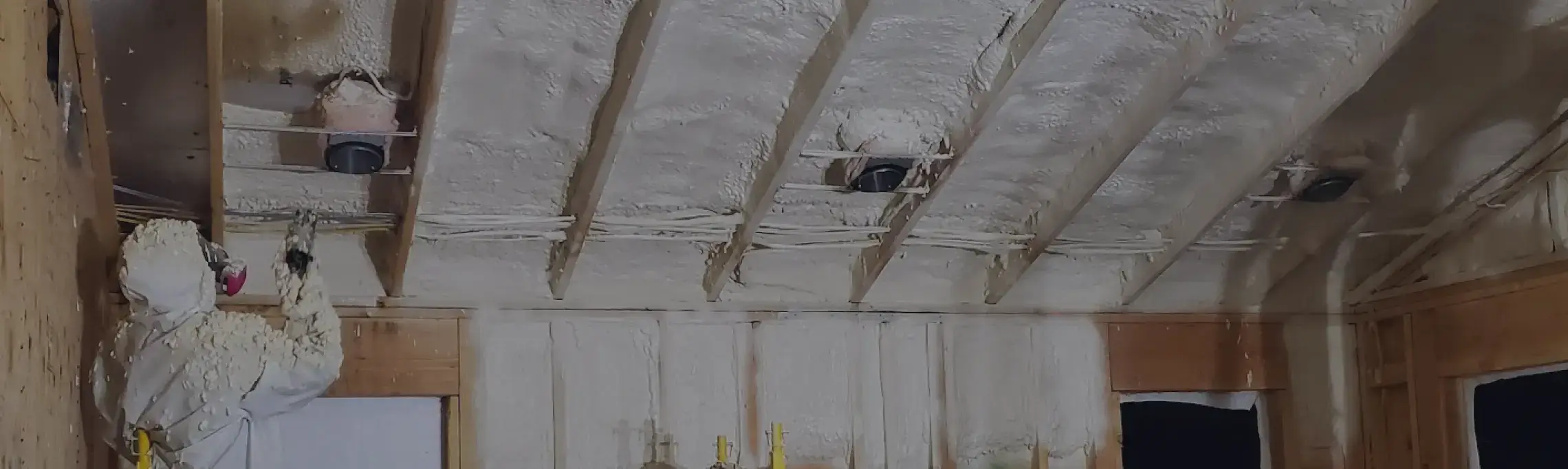
- Spray foam is insulation + air barrier in one; mineral wool is air-permeable and needs a separate air barrier
- Mineral wool is non-combustible (~1,800°F+) and excels at sound
- 2025 CA installed costs: mineral wool batts $1.50-3.00/ft², boards $3.50-6.00, open-cell $1.50-3.50, closed-cell $3.00-5.50
- Hybrid approach: foam for air/moisture, mineral wool for fire/sound
- How Spray Foam & Mineral Wool Actually Work
- Closed-Cell Spray Foam (ccSPF)
- Open-Cell Spray Foam (ocSPF)
- Key Properties
- Main Product Types
- R-Values & Thermal Performance (2025 Reality)
- Tight Cavities, Retrofits & Complex Geometry
- Continuous Exterior Insulation
- Standard 2×6 Walls & Vented Attics
- Cost: Upfront vs Lifecycle
- Key insights
- Air Sealing & Moisture Control
- Closed-Cell (moisture)
- Open-Cell (moisture)
- Air Control
- Moisture Management
- Fire, Sound & Safety
- Durability & Maintenance
- When to Use Each Material: Decision Guide
How Spray Foam & Mineral Wool Actually Work
SPF is applied as a liquid and bonds to substrates; mineral wool is made from melted rock and/or slag. Each material's core strengths are contrasted.
Spray Foam: Insulation + Air Barrier in One Pass
Foam forms a seamless, adhered layer bonded to framing and sheathing, solving air leakage by default so separate air barrier layers are less likely to fail.
Closed-Cell Spray Foam (ccSPF)
Density about 2.0 lb/ft³, R-6 to R-7 per inch. At typical thickness acts as air barrier and Class II vapor retarder and adds structural rigidity. Recommended for roofs, exterior walls, metal buildings, crawl spaces, rim joists, below-grade details.
- ~2.0 lb/ft³
- R-6 to R-7 per inch
- Class II vapor retarder
Open-Cell Spray Foam (ocSPF)
Density about 0.5 lb/ft³, R-3.5 to R-3.8 per inch. Air barrier that remains vapor-open so assemblies can dry. Suited to sound control, conditioned attics, interior partitions, drying-dependent assemblies.
- ~0.5 lb/ft³
- R-3.5 to R-3.8 per inch
Mineral Wool (Rockwool): Fire, Sound & Thermal Robustness
Dense, stable material with fire, sound and durability benefits. Air-permeable, so requires a separate air barrier to meet modern airtightness standards.
Key Properties
Non-combustible, tolerating roughly 1,800°F or higher. Strong sound absorption, water-resistant surface, resists rot and mold. Vapor-open, holds shape better than fiberglass, does not slump.
Main Product Types
Batts fill stud bays in walls, floors and attics. Boards/semi-rigid panels serve as continuous exterior insulation, rainscreen assemblies and fire-resistant façades.
R-Values & Thermal Performance (2025 Reality)
Presents R-value-per-inch comparison; both materials are serious insulation options with differences driven by application.
R-Value per Inch Comparison
Table of R-value per inch.
| Material | R-Value per Inch |
|---|---|
| Closed-cell spray foam | R-6.0 – R-7.0 |
| Open-cell spray foam | R-3.5 – R-3.8 |
| Mineral wool batts | ~R-3.7 – R-4.3 |
| Mineral wool exterior boards | ~R-4.0 – R-5.0 |
Where Each Material Wins
Closed-cell favored for constrained spaces, mineral wool for exterior boards, either for standard 2x6 walls.
Tight Cavities, Retrofits & Complex Geometry
Closed-cell's high R/inch and adhesion meet targets without furring out or reframing; suits existing 2x4 walls, shallow cathedral ceilings, irregular framing.
Continuous Exterior Insulation
Mineral wool boards provide a thermal break, non-combustible protection and vapor-open drying; tolerate UV and temperature extremes behind cladding.
Standard 2×6 Walls & Vented Attics
Both reach target R-values. Foam for near-guaranteed air sealing; mineral wool for non-combustibility and acoustics paired with a strong WRB and air barrier.
Cost: Upfront vs Lifecycle
Compares 2025 California installed costs and lifecycle economics; closed-cell's higher price can be offset by energy savings and fewer callbacks.
2025 Installed Costs (California)
Installed cost per square foot, lifespan, air-barrier status and notes.
| Material | Installed Cost ($/ft²) | Lifespan | Air Barrier | Notes |
|---|---|---|---|---|
| Mineral wool batts | 1.50 – 3.00 | 30–50 yrs | No | Fire & sound; needs air barrier |
| Mineral wool exterior boards | 3.50 – 6.00 | 30–50 yrs | No | Rainscreens & façades |
| Open-cell spray foam | 1.50 – 3.50 | 50–80 yrs | Yes | Air seal + acoustics |
| Closed-cell spray foam | 3.00 – 5.50 | 60–80+ yrs | Yes | High R/inch, moisture & structural help |
Key insights
Mineral wool batts and open-cell foam are priced closely, so performance goals should drive the choice. Closed-cell costs more but can replace cavity insulation, air barrier, vapor retarder and sometimes some structural bracing.
Quick Lifecycle Example (Conceptual)
2,000 sq ft California home: mineral wool with separate air barrier costs less upfront and saves about 15-25% on HVAC; closed-cell shell costs more but saves 25-40% and may allow smaller HVAC equipment.
- Mineral wool + air barrier: 15–25% HVAC savings
- Closed-cell shell: 25–40% HVAC savings, possible smaller HVAC
Air Sealing & Moisture Control
Spray foam offers predictable built-in control; mineral wool depends on well-executed air and vapor layers.
Spray Foam: Built-In Control
Closed-cell acts as air barrier and vapor retarder (coastal, roof, metal building, crawl space). Open-cell is an air barrier that stays vapor-open (conditioned attics, drying assemblies). SPF assemblies regularly test at or below 1.0 ACH50 versus a common target of 3 ACH50 or less.
- SPF assemblies ≤1.0 ACH50 vs common target ≤3 ACH50
Licensed, bonded & insured — free on-site inspections within 100 miles of San Francisco. Save $250 on orders over $2,500.
Closed-Cell (moisture)
Resists condensation and bulk water; fits coastal fog/humidity, low-slope roofs, metal buildings, storage facilities, crawl spaces, rim joists, below-grade transitions.
Open-Cell (moisture)
Allows moisture movement through the assembly; works for conditioned attics, sound-sensitive interiors, assemblies needing an escape path for moisture.
Mineral Wool: Excellent in the Right System
Can match spray foam's performance only if air and vapor layers are designed and built precisely; otherwise expect blower door results of 2.5-5.0+ ACH50.
- Without careful detailing: 2.5–5.0+ ACH50
Air Control
Mineral wool needs a continuous WRB/air barrier, sealed penetrations and transitions, interior air/vapor control; requires trade coordination and QC.
Moisture Management
Sheds and drains water, dries outward in rainscreens. Poor air sealing can still allow condensation behind it, causing hidden moisture damage even though the wool stays intact.
Fire, Sound & Safety
Mineral wool credited for fire and acoustic performance; spray foam is safe when covered by approved barriers.
Mineral Wool Fire Performance
Non-combustible, useful for fire ratings in walls, floors and shafts. Recommended for WUI zones, multifamily separations, commercial fire-rated assemblies; cites Oakland Hills, Marin and foothill communities.
Acoustic Performance
High-density batts and boards give strong sound absorption; recommended for party walls, floor/ceiling systems, theaters, studios, mechanical rooms.
Spray Foam Safety
Foam must be covered by approved thermal or ignition barriers and cannot be left exposed where code doesn't allow. Open-cell performs well in mid-to-high-frequency sound control; closed-cell valued mainly for structure and thermal.
Durability & Maintenance
Both engineered for long service; durability depends on different factors.
Spray Foam Longevity
Bonds permanently, doesn't slump, not attractive to pests. Modern HFO-based systems last about 60-80+ years; closed-cell resists bulk water, open-cell dries when designed correctly.
Mineral Wool Longevity
Inorganic, doesn't rot or feed mold. Service life 30-50+ years when protected from prolonged saturation; depends on surrounding air and weather barriers.
When to Use Each Material: Decision Guide
Scenarios favoring each material or a hybrid.
Choose Spray Foam When
Air sealing is critical; cavities shallow or geometry complex; moisture control matters; want one system for insulation, air barrier and vapor control; low ACH50 targets; retrofits where separate air barriers are hard to add.
Choose Mineral Wool When
Fire resistance required; acoustic performance matters; vapor-open non-combustible rainscreen needed; tight budgets when skilled trades can execute strong air barrier details.
Consider a Hybrid Approach When
Foam handles air and moisture control while mineral wool handles fire and sound. Suits buildings with differing zone priorities, flexible budgets, WUI sites that still need tight air sealing.
Experience You Can Trust
Served Northern California for over 15 years; insulated thousands of projects from single-family homes to large commercial buildings.
What Sets Us Apart
Code-compliant, low-GWP systems meeting 2025 environmental standards; licensed, insured, manufacturer-certified; tailored plans, warranties, help with inspector coordination.
Get an Instant Quote From a Licensed California Insulation Contractor
USA Spray Me (CSLB Lic# 1058008) installs spray foam, blow-in, fiberglass and soundproofing insulation, foam roofing and protective coatings throughout the San Francisco Bay Area and within 100 miles of the city. Call (855) 566-5340 or request a free inspection below — save $250 on orders over $2,500.