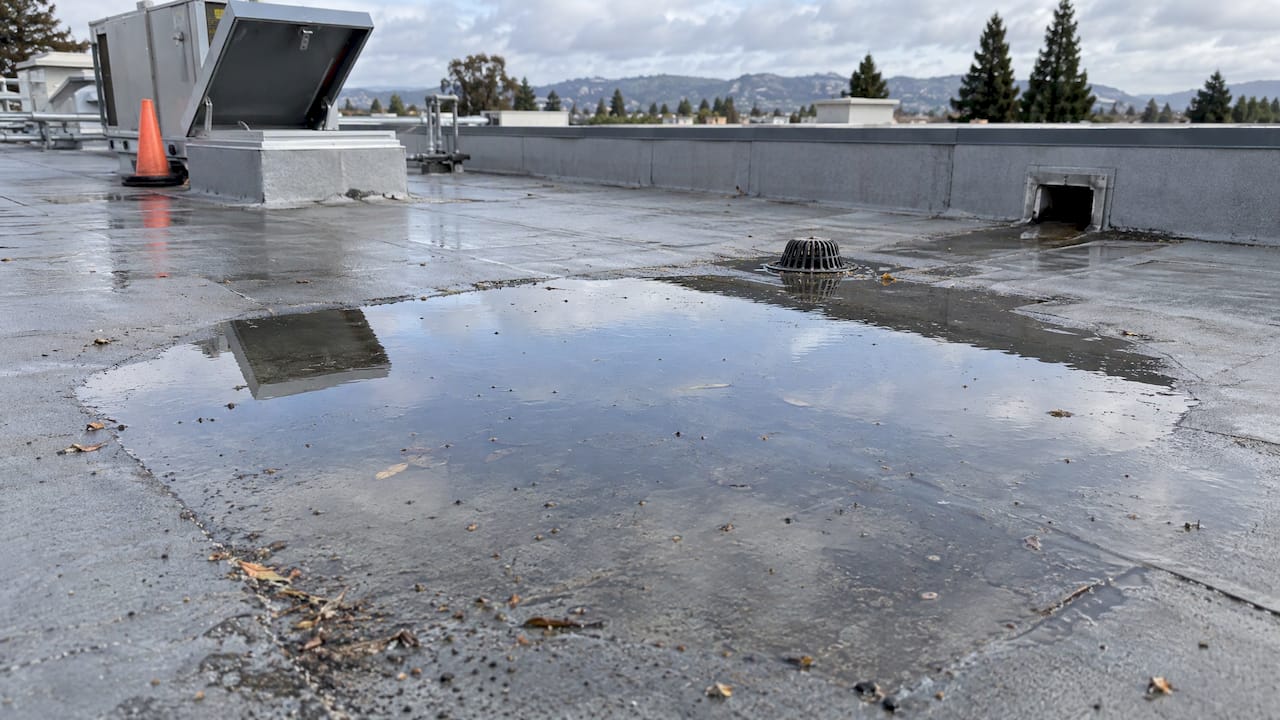
Water that is still sitting on your roof two days after the rain stopped is ponding, and it is a slope and drainage problem, not a surface blemish. A patch or a recoat on top of it treats the symptom. The lasting answer is to correct how the roof sheds water and to seal it without seams. That is the work our crews do on flat and low-slope roofs in the San Francisco Bay Area with our spray foam roofing system.
TL;DR
- Ponding is water that remains on a low-lying roof area more than 48 hours after precipitation, under conditions that should allow it to dry.
- Brief puddling is normal. Water that lingers past 48 hours can degrade membranes, grow vegetation, clog drains and, in the worst cases, overload the structure.
- The usual causes are too little slope, a sagging deck, and drains that are missing, blocked or set too high.
- Lasting fixes add slope or drainage: tapered insulation, sloped fills such as spray polyurethane foam, drains and scuppers at the low points, and crickets around equipment.
- Photograph the water 48 hours after a rain and have a roofer inspect the roof before you pay for a repair that skips the slope.
Table of Contents
- What counts as ponding water on a roof
- Is it normal for water to sit on a flat roof?
- What causes ponding water on a roof
- What ponding does to a roof over time
- How to check and document ponding on your roof
- How to fix and prevent ponding water
- Our view: fix the slope, then seal the roof
- Get a ponding roof assessed in the Bay Area
- FAQ
- Sources
What counts as ponding water on a roof
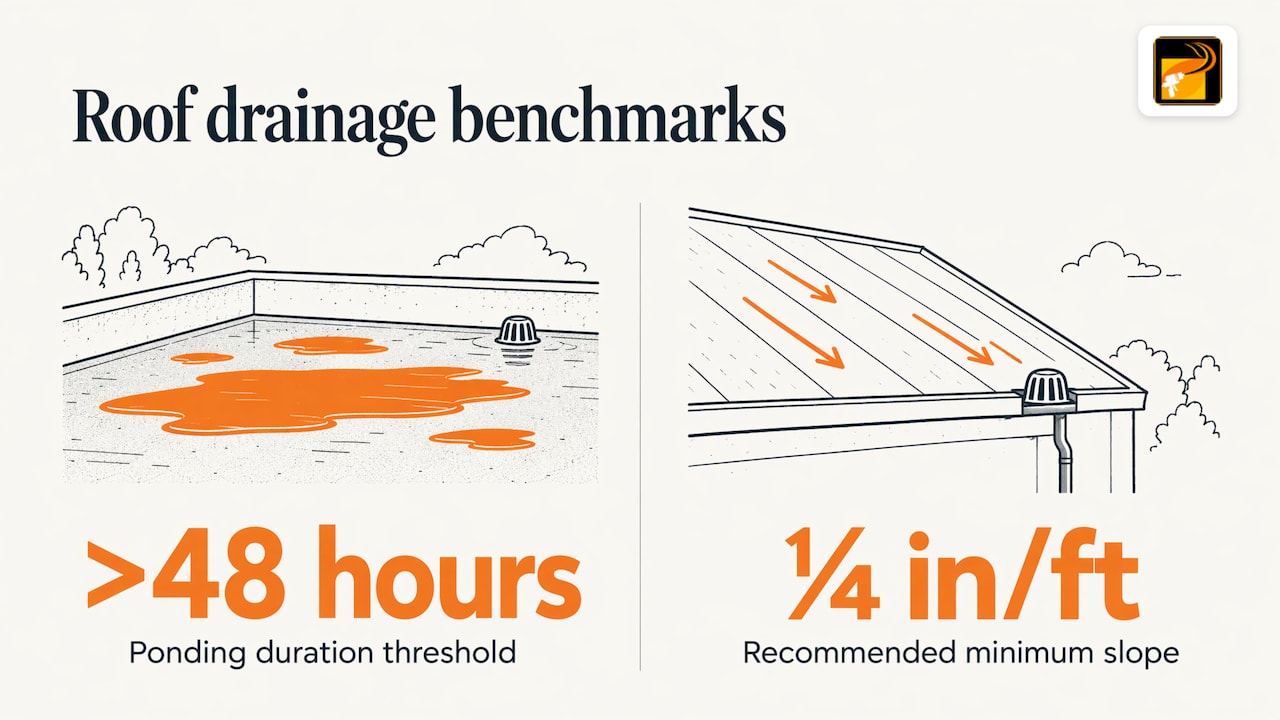
Not every puddle is ponding. The National Roofing Contractors Association (NRCA), the main trade body for roofers in the US, defines ponding as excessive accumulation of water in low-lying roof areas that remains more than 48 hours after precipitation under conditions conducive to drying.
That 48-hour line is the one most people use in practice. If you want a homeowner’s version of the rule and when to act on it, this 48-hour ponding guideline for homeowners walks through it.
The second number to know is slope. Despite the name, a flat roof is not level. Industry groups including ARMA, NRCA and IIBEC recommend a minimum slope of usually one quarter inch per foot so the roof drains freely for the life of the building. In other words, the roof should fall at least a quarter inch for every foot of run toward a drain or scuppers (the openings in a parapet wall that let water out).
Is it normal for water to sit on a flat roof?
For a short time, yes. NRCA’s guidance says short-duration ponding is unavoidable and acceptable to NRCA and membrane manufacturers, while ponding beyond 48 hours can be detrimental to the roof assembly.
How long a roof can tolerate water depends on what it is made of. NRCA’s survey of manufacturers found these acceptable ponding durations:
| Roof system | Acceptable ponding duration |
|---|---|
| Built-up asphalt | 48 hours |
| Polymer-modified bitumen | 48 hours |
| EPDM (rubber membrane) | 48 hours |
| TPO and PVC (single-ply membranes) | 48 hours to indefinite |
| Hot-applied graveled coal-tar | Indefinite |
The manufacturers’ answers are warranty-type positions, not a promise that your roof will be fine. Ponding that comes back after every storm in the same place is a sign the roof is not draining as designed, whatever the membrane.
What causes ponding water on a roof
Most ponding traces back to one of a handful of causes. The American Society of Home Inspectors lists four common ones: a design with no real slope, structural sagging, missing or inadequate drains, and drains that are blocked or set too high.
Structural engineers add detail. IIBEC’s article on why roofs pond names four design causes on roofs built to the minimum quarter-inch slope:
- Misreading the code’s “roof slope” as the “design slope” a roof actually needs.
- Deflection limits that are too loose (L/120 or L/180 instead of L/240).
- Ignoring the deflection that happens as soon as the dead load, meaning the roof’s own weight, is applied.
- The bowl shape that forms at the low end of a deflected member.
The code itself admits the gap. In the 2024 International Building Code, a footnote to the deflection table says those limits do not ensure against ponding, and roofs without enough slope or camber for drainage must be investigated further.
Where ponding shows up on commercial and residential roofs
The NRCA’s technical bulletin notes that low-slope roofs often pond next to parapets or equipment. Walk the roof and look at these spots first:
- Along parapet walls and curbs, where water has nowhere to go.
- Around rooftop HVAC units, vents and skylights.
- Midway between drains, where the roof can dip.
- Near drains that sit above the surrounding roof surface.
- Under condensate lines that discharge onto the roof instead of into a drain.
That last one matters more than it sounds: ARMA recommends connecting HVAC condensate lines to proper drains so units are not feeding the puddle.
What ponding does to a roof over time
The damage is gradual, which is why it gets ignored. ARMA’s 2024 bulletin on ponding lists these effects on low-slope roof systems:
- Deck deflection or deformation that may threaten structural integrity.
- Dirt and debris buildup that can cause alligator cracking (a pattern of cracks like reptile skin) and reduce reflectivity.
- Ice movement that can damage membranes.
- Biological growth that can attack membranes and clog drains.
- More water getting in if the membrane is already compromised.
For a building owner, the practical reading is simple: water that stays on the roof gets more chances to find a weak seam. A small flaw that would shed water on a sloped roof becomes a leak when the same spot sits under water for days. If you are already seeing stains inside, our guide to commercial roof leak repair covers what to do next.
The structural risk
The worst case is rare but serious. IIBEC explains a problem called ponding instability: water weight bends the deck, the bend holds more water, and the deflection progresses until it can exceed the structure’s strength and lead to collapse. The ASCE 7-16 standard requires framing analysis to prevent that progressive deflection.
If you see a roof deck visibly sagging, deep water that does not drain, or a roof that dips more each year, stop and have a structural engineer look at it. That is a safety question before it is a waterproofing question.
How to check and document ponding on your roof
A clear record makes any inspection faster and any repair quote more accurate. Do this only where you can reach the roof safely, or use photos from a ladder at the edge, a window or a drone-free vantage point.
- Wait for the right window. Look about 48 hours after the rain ends, in conditions that should let the roof dry. Standing water at that point is the ponding the code and manufacturers talk about.
- Photograph and measure. Take wide and close shots of each pool with something for scale, and note the approximate depth and where it sits relative to drains, parapets and equipment.
- Check the drains. Look for leaves, debris, vegetation and drains set above the roof surface. ARMA recommends keeping drains unobstructed through regular inspection and maintenance.
- Look inside. Stains on a ceiling may not sit under the real problem. NRCA’s bulletin notes that interior staining may not line up with the entry point because water travels sideways inside the roof assembly.
- Repeat after the next storm. A pool that returns in the same place every time points to slope or deck deflection, not a one-off blockage.
Do not flood-test the roof yourself to find a leak. The same NRCA bulletin warns that flood testing is not suitable, because roofs resist only minimal hydrostatic pressure from standing water. For a proper leak investigation it describes a seven-step process under ASTM D7035: documents, design review, service history, inspection, water testing, analysis and a report. Moisture mapping tools such as infrared thermography and capacitance meters can locate concealed wet insulation.
How to fix and prevent ponding water
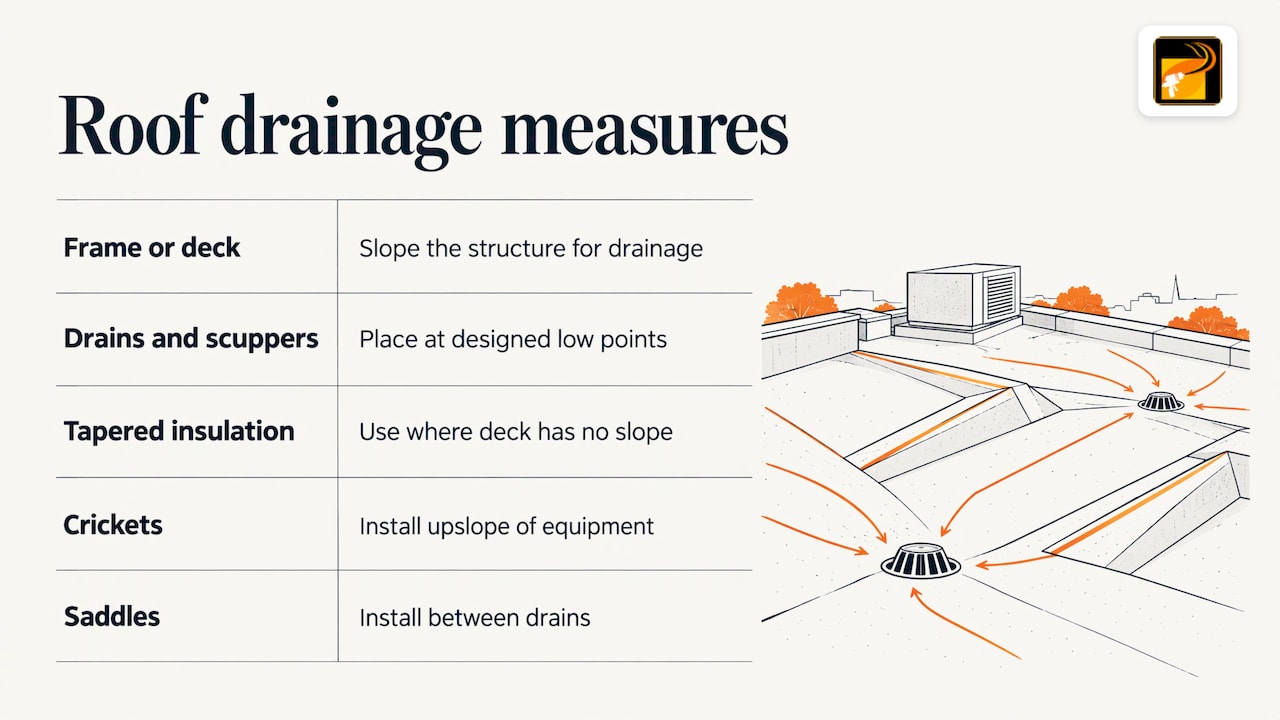
The fix depends on the cause, but the principle is constant: give the water a path off the roof. ARMA’s recommended measures include sloping the structural frame or deck, placing drains and scuppers at designed low points, using tapered insulation where the deck has no slope, and installing crickets upslope of equipment and saddles between drains. A cricket is a small raised ridge that diverts water around an obstruction.
The Department of Energy’s Pacific Northwest National Laboratory goes further in its re-roofing guide: low-slope roofs should never be flat, they must slope to drains or scuppers, and pooling water is a sign that more slope and more drains or scuppers are needed. It also says the structure should be inspected for rot and deficiencies before re-roofing.
Ways to add slope
NRCA lists several ways to build slope into a roof:
- Sloping the framing or deck during construction.
- Tapered insulation, which can also count toward code R-value.
- Sloped insulating fills, including lightweight insulating concrete, thermosetting fill and spray polyurethane foam.
- Placing drains, scuppers and gutters at the right locations.
NRCA also gives drainage details worth asking any contractor about: drains set in square tapered sumps sized to the drain bowl diameter plus about 24 inches, and crickets and saddles built at twice the slope of the adjacent roof field.
Code points that matter
The code sets the floor. NRCA’s summary of IBC 2012 says membrane roofs need a design slope of at least a quarter unit in 12 (2 percent), except coal-tar built-up roofs, and that reroofing is exempt from that minimum only when the roof system provides positive drainage. Where perimeter construction can trap water, the code also calls for secondary drainage, such as overflow drains or scuppers. The ASHI article suggests setting emergency scuppers 2 inches above the roof low point so they only discharge once the primary drain is overwhelmed.
In California, a roof project also has to meet the state’s energy and building code requirements, so slope, insulation and drainage should be planned together, not one at a time.
Why a surface patch rarely settles it
Patching a membrane where water sits deals with where the roof leaked, not why it held water. If the low spot remains, the water returns. Recoating a roof with ponding without changing slope or drains leaves the same load on the same seams. That is why the first question in any ponding job is not “what coating?” but “where should the water go?”
For the waterproofing side of the answer, see our guide to flat roof waterproofing methods. For how winter storms test Bay Area roofs, read about a leaking roof in California.
Our view: fix the slope, then seal the roof
We see ponding as two problems that have to be solved together: where the water goes, and what keeps it out while it is there. A roof that drains in 48 hours or less is a roof whose membrane is under far less stress.
That is why we handle the whole building envelope with our own crews. Insulation, roofing and coatings are connected: the layer that gives a roof its slope is often the same layer that insulates it, and the layer on top has to be continuous. Our spray foam roofing system is built for that kind of low-slope roof.
Our approach is transparent pricing with no upselling. If a smaller repair will solve your problem, we say so. If the roof needs slope and drainage corrected, we recommend that and explain why. Our crews are certified and licensed in California, we deliver work to California energy and building code standards, and we back our workmanship with a warranty.
USA
Get a ponding roof assessed in the Bay Area
If your flat or low-slope roof holds water after the 48-hour mark, the next step is a roof inspection by crews who install roofing and insulation in-house. USA Spray Me provides spray foam roofing systems for residential and commercial properties across the San Francisco Bay Area, delivered by certified crews licensed in California and backed by a workmanship warranty. Pricing for roofing is project-specific and is quoted after the roof is assessed. You can see everything we do on our services page, or contact us through usasprayme.com to arrange a visit.

Bring your photos from the 48-hour check, the roof’s age and any leak history. They shorten the inspection and help us scope the right fix, not the biggest one.
FAQ
How long can water sit on a flat roof before it is a problem?
About 48 hours. NRCA treats short-duration ponding as acceptable but says ponding beyond 48 hours can harm the roof assembly. Some membranes tolerate more, but recurring water in the same place is worth an inspection either way.
What causes ponding on a roof?
The common causes are too little slope, a deck that has sagged or deflected, and drains that are missing, blocked or set above the roof surface. Equipment and parapets also create pockets where water collects. Often more than one cause is at work.
Is ponding water on a roof an emergency?
Usually it is not an emergency, but it should not be left. Act quickly if you see a visibly sagging deck, deep water that is not draining or fresh interior leaks. In those cases, call a structural engineer and a roofing contractor right away.
How do you fix ponding water on a roof?
By changing how the roof drains. That means adding slope with tapered insulation or a sloped fill, adding or relocating drains and scuppers, building crickets around equipment, and clearing debris. The membrane or coating is then sealed over a roof that sheds water.
Sources
- Glossary, National Roofing Contractors Association
- 48-hour ponding guideline for homeowners
- ARMA, NRCA and IIBEC technical bulletin on the effects of ponding water, October 2024
- NRCA, proper roof slope and drainage, July 2012
- NRCA manufacturer survey on acceptable ponding durations
- NRCA, ways to build slope into a roof
- American Society of Home Inspectors, Flat Roof Drainage
- IIBEC, Why Does My Roof Pond?
- IIBEC, Raising the Bar in Standards: The ASCE 7 Standard and Low-Slope Roofs
- 2024 IBC Chapter 16, Structural Design
- NRCA WSRCA technical bulletin, Summer 2026
- PNNL Building America, Water Managed Roof guide
Recommended
- Flat Roof Waterproofing: Methods, Prep and What Lasts
- Commercial Roof Leak Repair: What to Do and How to Fix It
- How to Prevent Ice Dams: Fix the Attic, Not the Eaves
- Leaking Roof in California in 2025
Get an Instant Quote From a Licensed California Insulation Contractor
USA Spray Me (CSLB Lic# 1058008) installs spray foam, blow-in, fiberglass and soundproofing insulation, foam roofing and protective coatings throughout the San Francisco Bay Area and within 100 miles of the city. Call (855) 566-5340 or request a free inspection below. Save $250 on orders over $2,500.