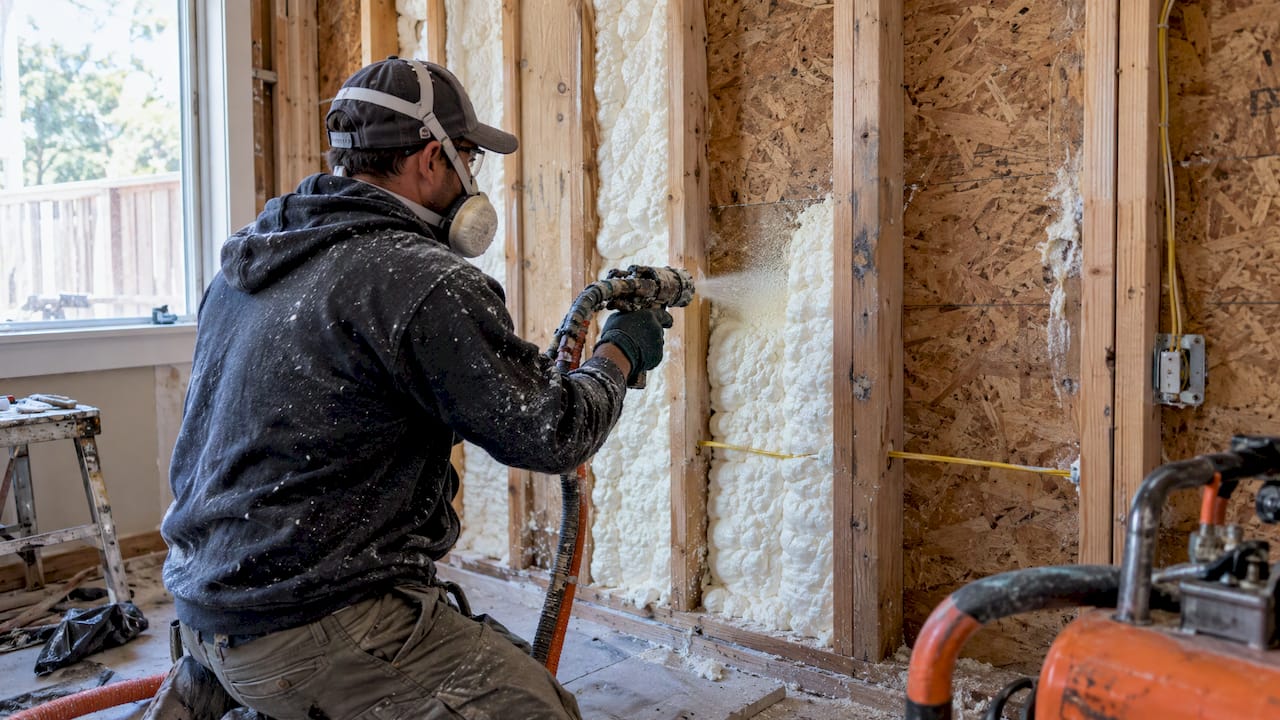
Spray foam is the one insulation that seals air leaks and insulates in the same pass. It goes on as a liquid, expands into gaps, cracks and voids, and cures into a continuous layer. That is why it suits Santa Rosa attics, crawlspaces, rim joists and commercial roofs where batts and loose fill leave bypasses. USA Spray Me installs it for homes and commercial properties across the North Bay, with certified crews and a workmanship warranty.
TL;DR
- Spray foam fills gaps as it expands, so it air-seals and insulates in one step, which fiberglass batts on their own do not do.
- Closed-cell foam also adds water resistance and a vapor barrier. Open-cell foam suits cavities where that is not needed.
- California’s 2022 Energy Code makes air sealing mandatory, and commercial buildings need a continuous air barrier statewide.
- Our published price ranges are $1.00-$2.50 per board foot for spray foam and $1.50-$2.50 for closed-cell.
- Foam only seals where it is applied, so windows, doors and moisture problems need to be handled in the same job.
Table of Contents
- How spray foam seals air leaks
- Where it goes in Santa Rosa buildings
- Open-cell or closed-cell for air sealing
- What affects the installed cost
- Seal the details, and fix moisture first
- California code and fire protection
- Will spray foam stop water?
- Our perspective
- Getting started in Santa Rosa
- FAQ
- Sources
How spray foam seals air leaks
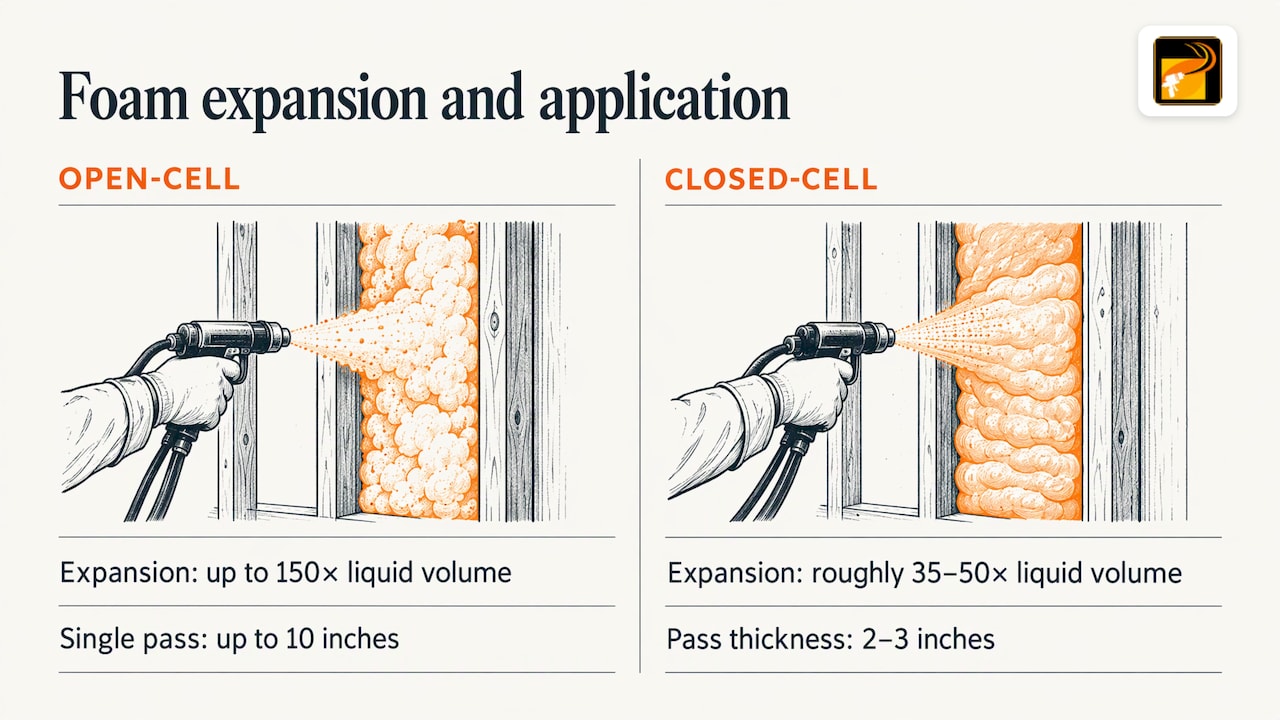
Air leaks through the small openings in a building: top plates, wiring and plumbing penetrations, rim joists, gaps around ducts. Fiberglass sits in a cavity and slows heat flow, but air moves through and around it. Spray foam works differently. The U.S. Department of Energy’s Building America guide explains that both open-cell and closed-cell foam air-seal well because the liquid expands to fill gaps, cracks and voids. Closed-cell foam expands roughly 35 to 50 times its liquid volume and goes on in 2 to 3 inch passes. Open-cell expands up to 150 times and can be applied up to 10 inches in one pass.
The Spray Polyurethane Foam Alliance’s homeowner guide adds that foam is the only insulation inside stud walls that can supply R-value, an air barrier and a vapor barrier in one product, with water resistance from closed-cell foam only. R-value is the measure of resistance to heat flow, so a higher number means better insulation.
Where it goes in Santa Rosa buildings
The same guide lists the places foam is commonly applied: unvented attics, cathedral ceilings, garage ceilings, crawlspaces, exterior walls, basement walls and around ductwork. In Sonoma County, the most common trouble spots are:
- Attics. Leaks around recessed lights, attic hatches and top plates let conditioned air escape. Foam on the underside of the roof deck can bring ducts inside the conditioned space.
- Crawlspaces and rim joists. Gaps where framing meets the foundation are a steady source of drafts and dampness.
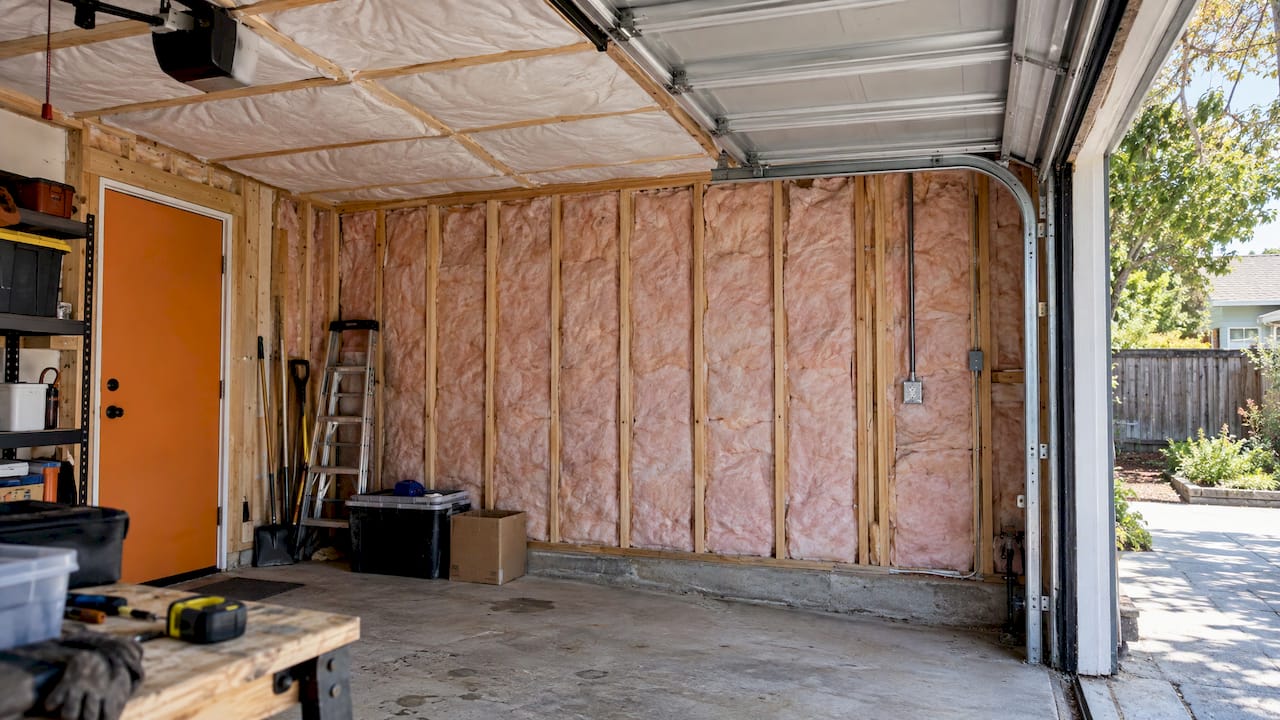
- Garage ceilings. Foam under rooms above a garage keeps floors warmer and stops fumes and cold air from traveling up.
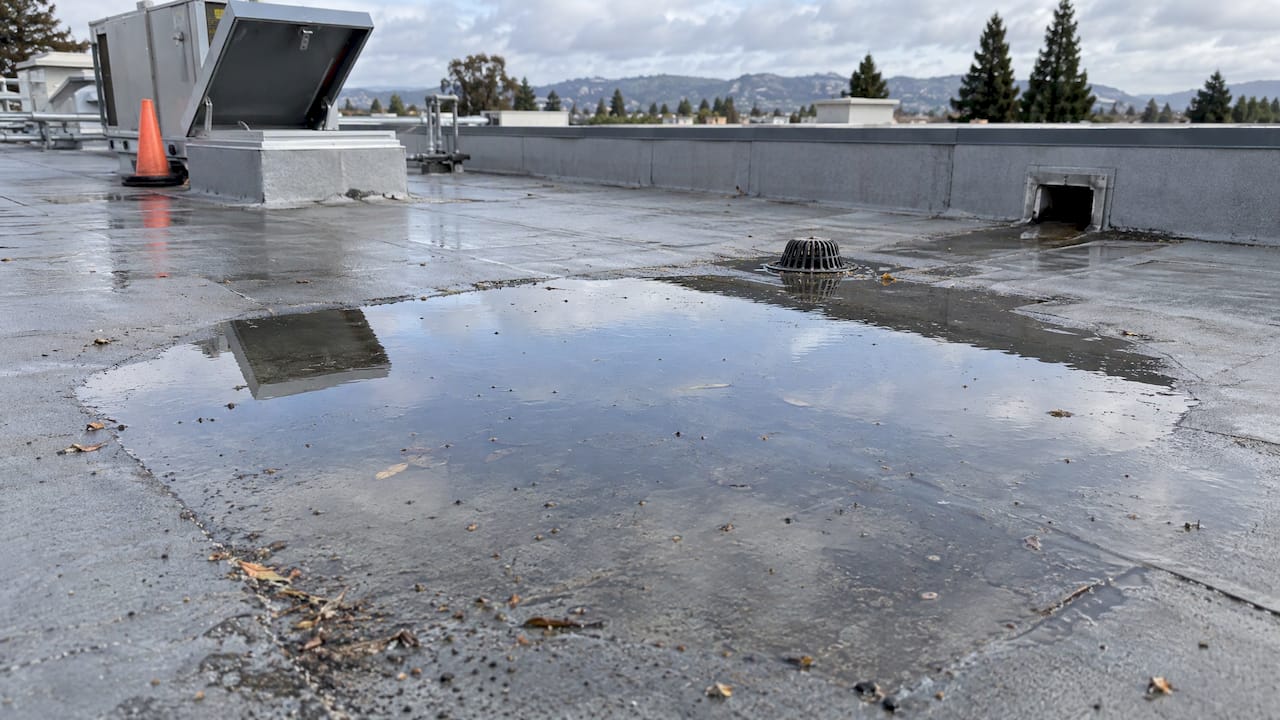
- Commercial roofs and walls. Foam can form a seamless layer over a roof or wall, with no joints for air to pass through.
If you are adding insulation to an older home, see our overview of spray foam insulation in Santa Rosa for how we approach local projects.
Open-cell or closed-cell for air sealing
Both types stop air. The choice depends on moisture, space and budget.
| Open-cell | Closed-cell | |
|---|---|---|
| Typical R-value | About 3.6 per inch | Exceeds R-30 at a full 5-inch cavity |
| Air barrier | Yes | Yes |
| Vapor barrier | No (5 to 10 perms at 5 inches) | Yes |
| Water | Can absorb up to a third of its volume | Resists liquid water |
The figures come from the Building America guide. Closed-cell foam is the stronger choice for crawlspaces, below-grade walls, roofs and any place that may see moisture. Our closed-cell insulation service is priced at $1.50-$2.50 per board foot, and our general spray foam insulation service at $1.00-$2.50 per board foot. A board foot is one square foot of surface at one inch thick, so a 1,000 square foot attic deck at 3 inches is 3,000 board feet. For a side-by-side with cost and R-values, read our closed-cell vs open-cell guide.
For comparison, our fiberglass insulation is $0.50-$2.50 per sq ft and blow-in insulation is $1.20-$3.50 per sq ft. Those are different units, so compare quotes by finished R-value and area, not by headline number. Our honest approach is to tell you when a less expensive option will do the job, and to price only what your building needs.
What affects the installed cost
The final price per project depends on a few things you can see in advance:
- Thickness. Board-foot pricing multiplies by depth, so reaching a target R-value in a deep rafter bay costs more than a shallow cavity.
- Foam type. Closed-cell sits at the higher end per board foot but delivers more R-value per inch.
- Access and prep. Finished walls are harder to treat. The Energy Star measure guideline notes that spray foam is typically the most expensive way to add insulation to an existing wall, which is why attics, crawlspaces and open framing are where foam pays back fastest.
- Removal. Old insulation may need to come out first. Our removal service is $1-$2 per sq ft.
The energy payoff comes from the air sealing as much as the R-value, so a well-targeted job often matters more than a bigger one.
Seal the details, and fix moisture first
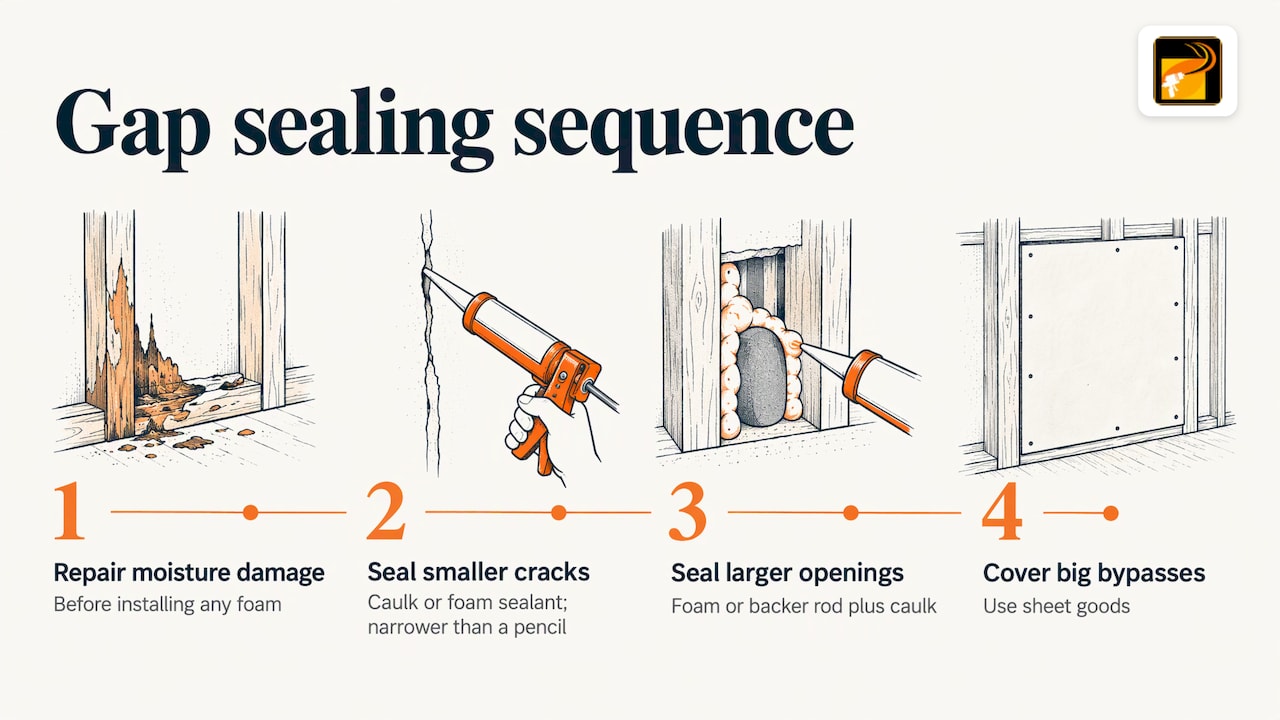
Foam stops air only where it is installed. The authors of the NAHB Research Center and DOE measure guideline stress that wall air sealing and insulation are one retrofit: details around windows, doors and plates have to be sealed too, and any moisture damage found in the façade, sheathing or framing is repaired before foam goes in. The guideline also sets the method by gap size: caulk or foam sealant for cracks smaller than a pencil width, foam or backer rod plus caulk for larger openings, and sheet goods for big bypasses.
Doors are a frequent leak that insulation alone does not fix. If you have older wood doors, this guide on weatherstripping wood doors shows how to seal them without losing their character.
A properly sealed home still needs fresh air. SPFA’s guide notes that foam homes need controlled mechanical ventilation, which counters the myth that a sealed house cannot breathe.
On commercial buildings, closed-cell foam can act as water, air, vapor and thermal control layers at once. Building Science Corporation’s commercial spray foam guide says it must be sprayed directly onto block or sheathing and not directly to windows, where an extended buck with flashing is required. These are details a trained crew handles at the design stage.
California code and fire protection
Air sealing is no longer optional in California. The Energy Commission’s 2022 Energy Code guidance makes air sealing mandatory for all buildings under §110.7, and calls for a continuous air barrier in nonresidential buildings. Closed-cell foam qualifies at a minimum 2.0 pcf density and 2 inches thickness. Air-barrier assemblies may leak no more than 0.04 cfm per square foot on average. The Technical Services Information Bureau reports the continuous air barrier requirement expanded to the whole state on January 1, 2023, with compliant closed-cell foam at least 1½ inches thick at 1.5 pcf.
For fire safety, foam is generally covered by a thermal barrier. Evaluation reports for California-listed products show, for example, that foam up to 2 inches calls for a ½-inch gypsum thermal barrier, and another product allows an ignition barrier to be omitted in utility-only attics and crawlspaces when a specified coating thickness is used. Each product has its own conditions, which is why the right covering depends on the exact foam and location. State law also requires foam systems to be listed and labeled by an approved testing agency.
Our crews work to California energy and building code standards. For the residential and commercial requirements in detail, see our Title 24 insulation guide and the air sealing guide for passing Title 24.
Will spray foam stop water?
Closed-cell foam resists liquid water and works as a vapor barrier, so it helps in damp crawlspaces and roofs. It does not repair a leaking roof, window or wall. If water is getting in, the source has to be found and repaired first, then foam goes over a sound surface. Open-cell foam can absorb water, so it belongs in dry cavities.
Our perspective
Most air-leak problems we are called to are not insulation problems alone. They are envelope problems: a cold attic, a drafty crawlspace, a roof that sheds air and moisture at every seam.
That is why we keep the whole building envelope in-house. Insulation, spray foam roofing, removal and coatings are handled by our own certified crews, licensed in California, so the air barrier is continuous instead of being split between trades.
We price transparently and do not upsell. If fiberglass or blow-in will do the job for your attic, we say so. If closed-cell foam is the right answer for a crawlspace or a roof, we explain why and quote it by the board foot. Every job is built to California energy and building code and comes with a workmanship warranty.
USA
Getting started in Santa Rosa
Start with the areas that lose the most air: the attic plane, the crawlspace and the rim joists. Our spray foam insulation service covers homes and commercial properties, and our commercial insulation and spray foam roofing services handle larger buildings. We publish our price ranges so you can budget before the first call.

If your building has old or damaged insulation, we also handle insulation removal before the new work begins. Contact us through our site for a quote on your Santa Rosa property.
FAQ
Will spray foam stop water from coming in?
Closed-cell foam resists liquid water and acts as a vapor barrier, so it protects against dampness in crawlspaces and roofs. It does not fix an active leak, so the source of the water is repaired first and the foam goes on afterward.
How much more expensive is spray foam than other insulation?
Our published ranges are $1.00-$2.50 per board foot for spray foam and $1.50-$2.50 for closed-cell. Fiberglass is $0.50-$2.50 per sq ft and blow-in is $1.20-$3.50 per sq ft. Foam costs more per square foot of coverage because it also air-seals, and we recommend a cheaper option where it will do the job.
Does spray foam need a fire barrier?
Generally yes. Product evaluation reports typically call for a ½-inch gypsum thermal barrier over foam, with limited exceptions for attics and crawlspaces that are not living space. The exact requirement depends on the product and location, and our crews apply foam to California code.
Does spray foam make a house too airtight?
No. A well-designed foam home uses controlled mechanical ventilation to bring in fresh air while limiting energy loss, so the house gets fresh air on purpose instead of through leaks.
Sources
- Which Spray Foam Is Right For You? (U.S. DOE Building America)
- A Homeowner’s Guide to Spray Polyurethane Foam (SPFA)
- Measure Guideline: Wall Air Sealing and Insulation Methods in Existing Homes (Energy Star)
- GM-2103: Commercial Spray Foam Guide (Building Science Corporation)
- 2022 Energy Code Nonresidential Envelope (California Energy Commission)
- California air barrier bulletin (Technical Services Information Bureau)
- ESR-3052 evaluation report
- ESR-3183 evaluation report
- California Health & Safety Code, foam building systems
- Weatherstripping wood doors
Recommended
- Best Commercial Insulation Options in Santa Rosa
- Santa Rosa: Spray Foam Insulation for Custom Homes
- Top Spray Foam Insulation Contractors In Sonoma Valley
Get an Instant Quote From a Licensed California Insulation Contractor
USA Spray Me (CSLB Lic# 1058008) installs spray foam, blow-in, fiberglass and soundproofing insulation, foam roofing and protective coatings throughout the San Francisco Bay Area and within 100 miles of the city. Call (855) 566-5340 or request a free inspection below. Save $250 on orders over $2,500.